
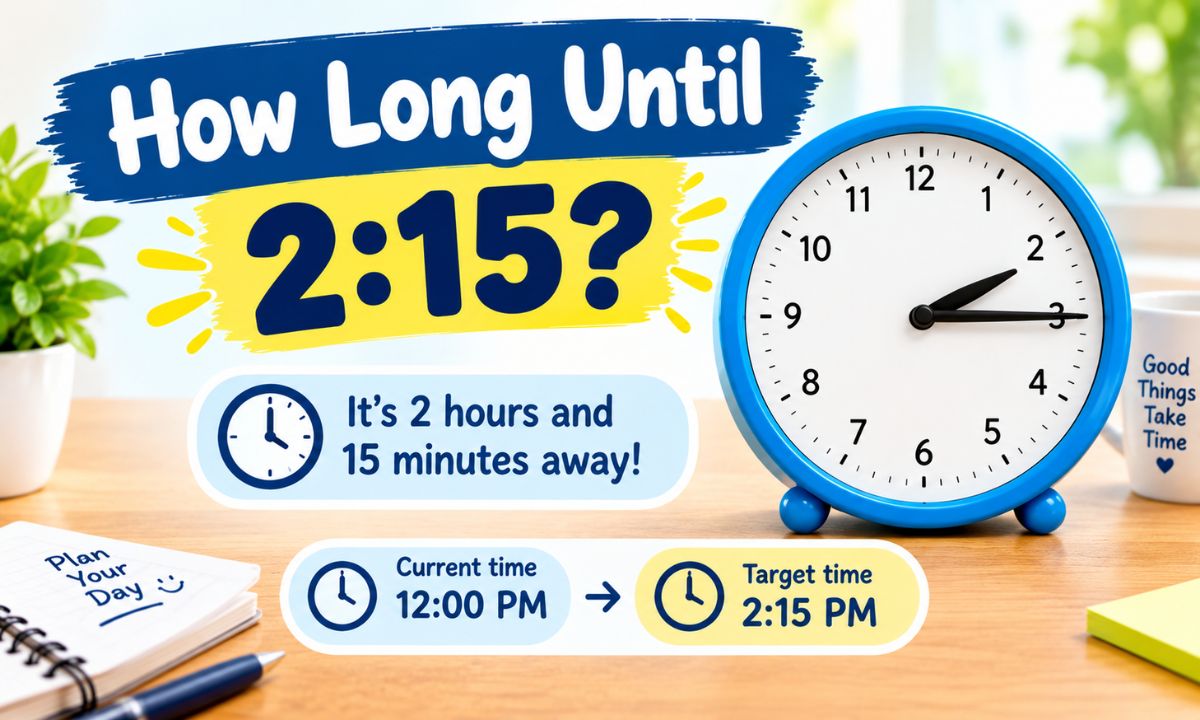
Are you staring at the clock and wondering exactly how long until 2:15? Keeping track of the exact minutes left in your afternoon is crucial, whether you are counting down to an upcoming shift change, a school dismissal, or an important client presentation.
When you know how to calculate the remaining time instantly, managing your daily schedule becomes completely stress-free.Fortunately, mastering a few quick math shortcuts can clear up any confusion about time tracking.
Quick Answer
The time remaining until 2:15 changes based on your current time, since 2:15 happens twice every day, once in the morning and once in the afternoon. To find it, subtract your current time from 2:15 (using 14:15 in 24-hour format for the PM version). If the result is negative, add 24 hours and you’ll get the countdown to the next occurrence.
For example, if it’s currently 11:00 AM, you have 3 hours and 15 minutes until 2:15 PM. If it’s currently 9:30 PM, you have roughly 4 hours and 45 minutes until 2:15 AM the next day.
Why People Search “How Long Until 2:15”
This search comes up more often than you’d think, and for a range of practical reasons. Most people typing this into Google aren’t doing abstract math homework. They’re trying to plan something specific.
Common reasons people look this up include:
- Appointments and meetings: Someone scheduled a doctor’s visit, work call, or interview at 2:15 and wants to know how much time is left to prepare.
- Flight or train departures: A boarding time or departure listed as 2:15 often prompts a quick countdown check.
- School and work schedules: Students and employees track class dismissal or shift-end times that land at 2:15.
- Cooking and timers: Recipes with finish times set for 2:15 need a quick mental countdown.
- Live events: Streams, sports broadcasts, or webinars starting at 2:15 send people searching for an exact wait time.
- Deadlines: Submission windows closing at 2:15 create urgency and a need for precision.
Whatever the reason, the underlying math is the same, and it’s simpler than most people assume.
How to Calculate Time Until 2:15
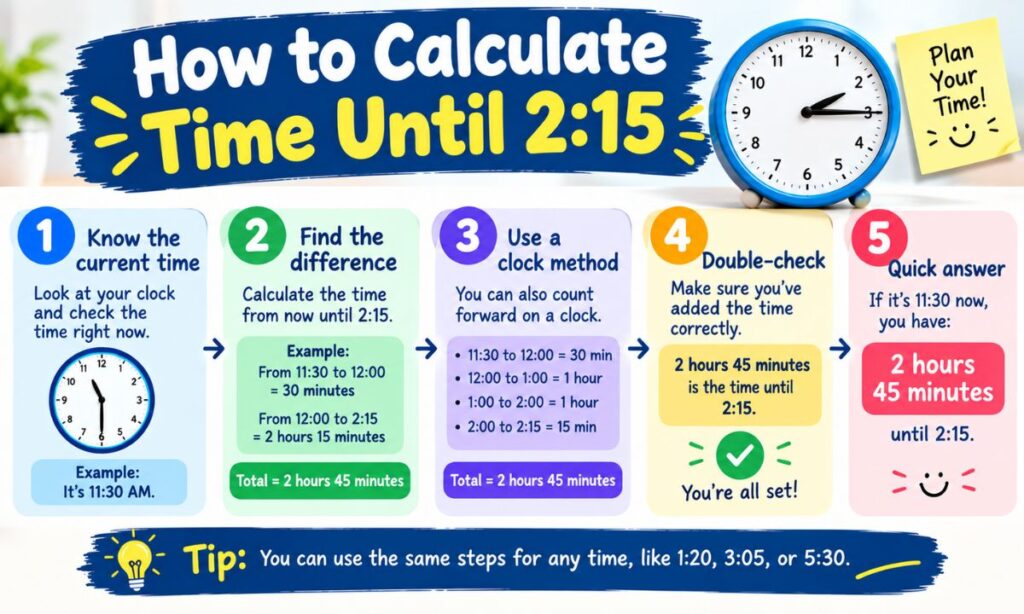
Here’s the straightforward process anyone can follow without a calculator app.
Step 1: Confirm Which 2:15 You Mean
Since 2:15 appears twice daily, decide first whether you’re counting toward 2:15 AM or 2:15 PM. This single decision changes the entire calculation, so don’t skip it.
Step 2: Convert to 24-Hour Time
Convert both your current time and your target time into 24-hour format. This removes AM/PM confusion entirely.
- 2:15 AM becomes 02:15
- 2:15 PM becomes 14:15
Step 3: Subtract Current Time From Target Time
Take the target time and subtract your current time from it. Handle hours and minutes separately, then combine them.
Step 4: Adjust for Negative Results
If your subtraction gives a negative number, it means the target time already passed today. Add 24 hours to the result to get the countdown to tomorrow’s occurrence instead.
Step 5: Simplify Into Hours and Minutes
Convert any leftover minutes above 60 into full hours, then state your answer in plain hours and minutes for clarity.
Time Until 2:15 PM From Different Starting Points
Here’s a table showing exactly how long until 2:15 PM from common times of day.
| Current Time | Time Until 2:15 PM |
| 6:00 AM | 8 hours 15 minutes |
| 8:30 AM | 5 hours 45 minutes |
| 10:00 AM | 4 hours 15 minutes |
| 11:45 AM | 2 hours 30 minutes |
| 12:00 PM | 2 hours 15 minutes |
| 1:00 PM | 1 hour 15 minutes |
| 1:50 PM | 25 minutes |
| 2:00 PM | 15 minutes |
| 3:00 PM | 23 hours 15 minutes (next day) |
Time Until 2:15 AM From Different Starting Points
If you’re tracking the early morning version instead, use this table.
| Current Time | Time Until 2:15 AM |
| 6:00 PM | 8 hours 15 minutes |
| 8:00 PM | 6 hours 15 minutes |
| 10:30 PM | 3 hours 45 minutes |
| 11:59 PM | 16 minutes |
| 12:15 AM | 2 hours |
| 1:00 AM | 1 hour 15 minutes |
| 1:45 AM | 30 minutes |
| 2:15 AM | 0 minutes (right now) |
| 3:00 AM | 23 hours 15 minutes (next day) |
Formula Conversions and Unit Breakdowns
Sometimes hours and minutes aren’t the unit you need. Here’s how to convert a countdown to 2:15 into other useful formats.
| Time Remaining | In Minutes | In Seconds | In Decimal Hours |
| 1 hour 0 minutes | 60 minutes | 3,600 seconds | 1.00 hours |
| 2 hours 15 minutes | 135 minutes | 8,100 seconds | 2.25 hours |
| 3 hours 30 minutes | 210 minutes | 12,600 seconds | 3.50 hours |
| 4 hours 45 minutes | 285 minutes | 17,100 seconds | 4.75 hours |
| 6 hours 15 minutes | 375 minutes | 22,500 seconds | 6.25 hours |
To convert hours and minutes into decimal hours yourself, divide the minutes by 60 and add that to the whole hour count. For instance, 45 minutes divided by 60 equals 0.75, so 4 hours 45 minutes becomes 4.75 hours.
Real-World Application Scenarios
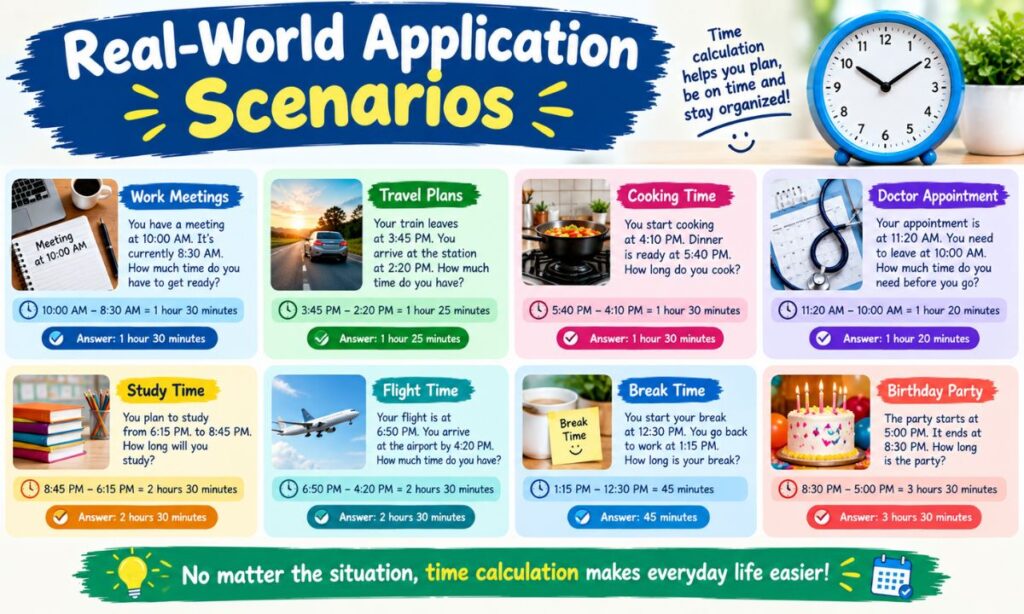
Understanding the math is one thing, but seeing it applied to actual situations makes it stick.
Scenario 1: Catching a flight. Your boarding pass says boarding starts at 2:15 PM, and it’s currently 12:40 PM at the airport. That leaves you 1 hour and 35 minutes to clear security, grab food, and reach your gate.
Scenario 2: A work deadline. Your manager wants a report submitted by 2:15 PM, and the clock reads 9:50 AM. You have exactly 4 hours and 25 minutes to finish and send it.
Scenario 3: Setting an alarm. You want to wake up in time for a 2:15 AM shift start, and you’re going to bed at 7:00 PM. That gives you 7 hours and 15 minutes of potential rest before the alarm needs to go off.
Scenario 4: A recipe timer. Dinner needs to be ready by 2:15 PM, and prep started at 1:30 PM. That’s a 45-minute window to get everything cooked and plated.
Scenario 5: A live stream premiere. A creator announces their video goes live at 2:15 PM, and a fan checks at 2:05 PM. Only 10 minutes stand between them and the premiere.
Common Mistakes and Misconceptions
A few errors show up again and again when people try to calculate this manually.
- Mixing up AM and PM: This is the single most frequent mistake. Always double-check whether you’re counting toward the morning or afternoon version of 2:15 before doing any math.
- Forgetting to carry over hours: When subtracting minutes and the result goes negative, people often forget to borrow an hour, which throws off the entire answer.
- Ignoring the date rollover: If the target time already passed today, the countdown rolls into tomorrow. Skipping this step gives a nonsensical negative answer.
- Assuming time zones automatically match: If you’re coordinating with someone in a different time zone, 2:15 in their location isn’t 2:15 in yours. Always confirm which time zone the target refers to.
- Rounding too early: Rounding minutes before finishing the full calculation can throw off the final total by several minutes, which matters for tight schedules.
Related Calculations and Topics
If this kind of countdown math is useful to you, these related calculations follow the exact same logic and are worth knowing too.
- How long until 2:00: A close relative of this calculation, useful for anyone tracking the top of the 2 o’clock hour instead.
- How long until 2:30: Fifteen minutes past the mark covered here, handy for slightly later appointments or events.
- How long until 3:00 PM: A common one-hour-later variation for people whose schedules shift by 45 minutes.
- Time zone converters: Essential when the 2:15 you’re counting toward is in a different region than you are.
- Elapsed time calculators: Useful for figuring out how much time has passed since an earlier event, rather than how much remains.
- Work hours calculators: Helpful for anyone converting a countdown into billable or shift hours.
Conclusion
Figuring out how long until 2:15 comes down to one core skill: knowing whether you mean the morning or afternoon version, converting to 24-hour time, and subtracting carefully. Once you’ve done it a few times, the math becomes second nature, and you won’t need a calculator or an app to get a reliable answer.
Whether you’re catching a flight, hitting a deadline, or just curious, the method above works every time.
Frequently Asked Questions
How do I know if 2:15 means AM or PM?
Check the context of what you’re counting down to. A boarding pass, work shift, or event listing will usually specify AM or PM directly, so read the original schedule carefully.
What if it’s already past 2:15 today?
Add 24 hours to your calculation. This gives you the countdown to the next occurrence of 2:15, which will happen tomorrow instead of today.
Is there a difference between 2:15 and 14:15?
No, they represent the same moment in time. 14:15 is simply the 24-hour format equivalent of 2:15 PM, commonly used in international and military time systems.
Can I calculate this without converting to 24-hour time?
Yes, but it’s easier to make mistakes with AM/PM subtraction. Converting first removes ambiguity and reduces the chance of an error in your final answer.
How many minutes are there between now and 2:15 if I’m not sure of the exact current time?
Check any digital clock or phone display for the precise current time, then apply the subtraction method above. Precision at the start step ensures an accurate final countdown.

James Anderson is a passionate English grammar writer at GlobalMegzine, sharing simple language tips, word meanings, slang guides, and easy grammar knowledge for everyday readers.