
Are you constantly checking the clock and wondering how long until 12 PM? Whether you are counting down to a lunch break, an important business meeting, or a strict project deadline, tracking the exact time left until noon is essential for staying on schedule.
Managing your day becomes much easier when you can calculate these remaining hours and minutes quickly and accurately.Fortunately, mastering a few simple time calculation methods can eliminate all confusion.
Quick Answer
The time remaining until 12 PM depends entirely on your current time, since “how long until noon” is a moving target throughout the day. As a general rule, subtract your current hour and minute from 12:00 using standard clock subtraction. If it’s 9:15 AM right now, you have 2 hours and 45 minutes left until noon. If it’s already past noon, you’re calculating for the next day’s 12 PM instead, which means adding the hours remaining until midnight to the hours from midnight to noon.
Why “How Long Until 12 PM” Depends on Your Starting Point
Noon sits at a fixed spot on the clock, but your question changes shape depending on when you ask it. Someone checking at 7 AM is doing a short subtraction problem. Someone checking at 11:58 PM the night before is really asking about a full overnight stretch.
This is why a single flat answer doesn’t work here. The honest response is always a calculation, not a memorized fact. Once you know the starting time, the math itself is simple arithmetic that takes seconds once you know the pattern.
There’s also a psychological layer to why noon feels different from other hours. It’s the one time of day that splits the clock into two clean halves, morning and afternoon, which is probably why so many routines and deadlines get built around it. That makes the “how long until” question feel more urgent than asking about a random hour like 2 PM or 4 PM.
How to Calculate Time Until 12 PM
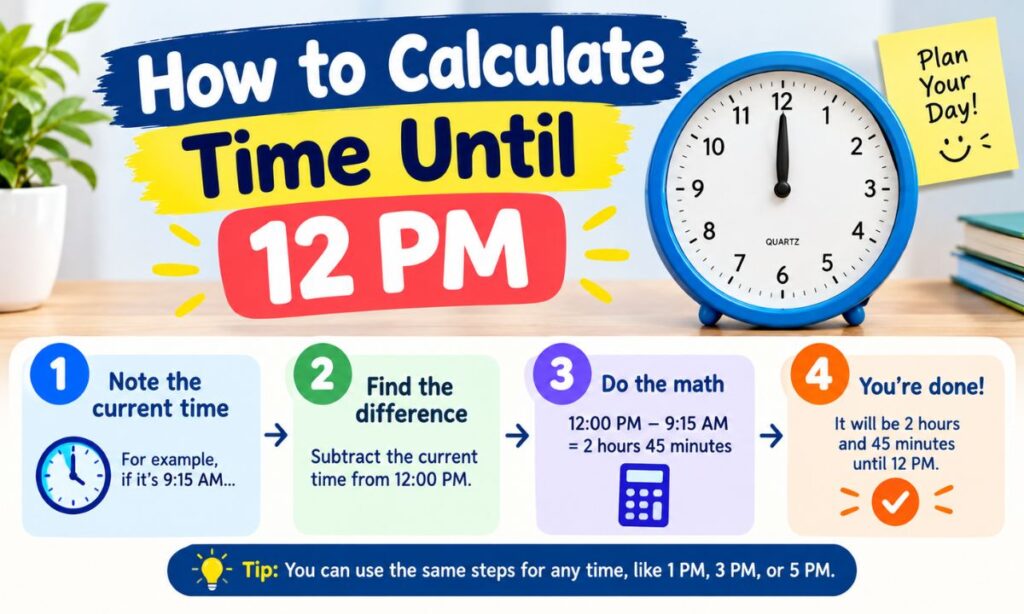
Follow this process any time you need to work out the gap between now and noon.
Step 1: Write down the current time in 24-hour format. Converting to 24-hour format removes the AM/PM confusion that trips people up. For example, 9:15 AM becomes 09:15, and 3:40 PM becomes 15:40.
Step 2: Set your target as 12:00. Noon in 24-hour format is simply 12:00, which keeps the subtraction clean.
Step 3: Subtract the current time from 12:00 if you’re still in the morning. If your current time is earlier than noon, subtract hours and minutes separately, borrowing from the hour column when the minutes don’t divide evenly.
Step 4: If it’s already past noon, calculate toward the next day’s 12 PM. Subtract your current time from 24:00 to find how long until midnight, then add 12 hours to reach the following noon.
Step 5: Double check by counting forward. Add your calculated duration back to the starting time and confirm you land exactly on 12:00. This catches small subtraction errors before they cause confusion.
Worked Example
Say it’s currently 8:37 AM and you want to know how long until 12 PM.
Start with 12:00 and subtract 08:37. Since 37 minutes is more than zero minutes, borrow one hour from the hour column, turning 12:00 into 11:60. Now subtract: 60 minus 37 equals 23 minutes, and 11 minus 8 equals 3 hours.
The answer is 3 hours and 23 minutes.
Now try a second example starting from the previous evening. Say it’s currently 10:20 PM and you need to know how long until the next day’s noon. First, find the gap to midnight, which is 1 hour and 40 minutes. Then add the standard 12 hours from midnight to noon. That gives a total of 13 hours and 40 minutes. This two-step method works for any evening or overnight starting point, and it avoids the confusion of trying to subtract across a date change in a single step.
Countdown Table: Common Starting Times to 12 PM
Use this table for quick lookups without doing the math yourself.
| Current Time | Time Until 12 PM |
| 6:00 AM | 6 hours 0 minutes |
| 7:30 AM | 4 hours 30 minutes |
| 8:15 AM | 3 hours 45 minutes |
| 9:00 AM | 3 hours 0 minutes |
| 9:45 AM | 2 hours 15 minutes |
| 10:20 AM | 1 hour 40 minutes |
| 11:00 AM | 1 hour 0 minutes |
| 11:30 AM | 30 minutes |
| 11:55 AM | 5 minutes |
Countdown Table: Starting From the Previous Evening
This table covers the overnight stretch, for anyone calculating time until noon starting the night before.
| Current Time (Previous Day) | Time Until 12 PM |
| 6:00 PM | 18 hours 0 minutes |
| 9:00 PM | 15 hours 0 minutes |
| 11:00 PM | 13 hours 0 minutes |
| 11:59 PM | 12 hours 1 minute |
| 12:00 AM (midnight) | 12 hours 0 minutes |
| 3:00 AM | 9 hours 0 minutes |
Real-World Scenarios Where This Calculation Matters
Knowing how long until 12 PM isn’t just trivia. It comes up constantly in ordinary situations.
- Work shift planning: Someone starting an early shift often needs to know exactly how many hours remain before their lunch break lines up with noon.
- Fasting windows: People doing intermittent fasting frequently set noon as their eating window start, making this countdown a daily check-in.
- Flight and travel connections: Travelers with a noon departure or noon layover deadline use this calculation to pace their morning.
- Exam and appointment countdowns: Students and patients with a noon exam or appointment often track the remaining hours as the morning progresses.
- Cooking and meal prep timing: Recipes that need to be ready by noon, such as lunch service prep, rely on this exact countdown to stay on schedule.
- Live event and stream scheduling: Hosts counting down to a noon broadcast or livestream use this math to time their final preparations.
Common Mistakes People Make With This Calculation
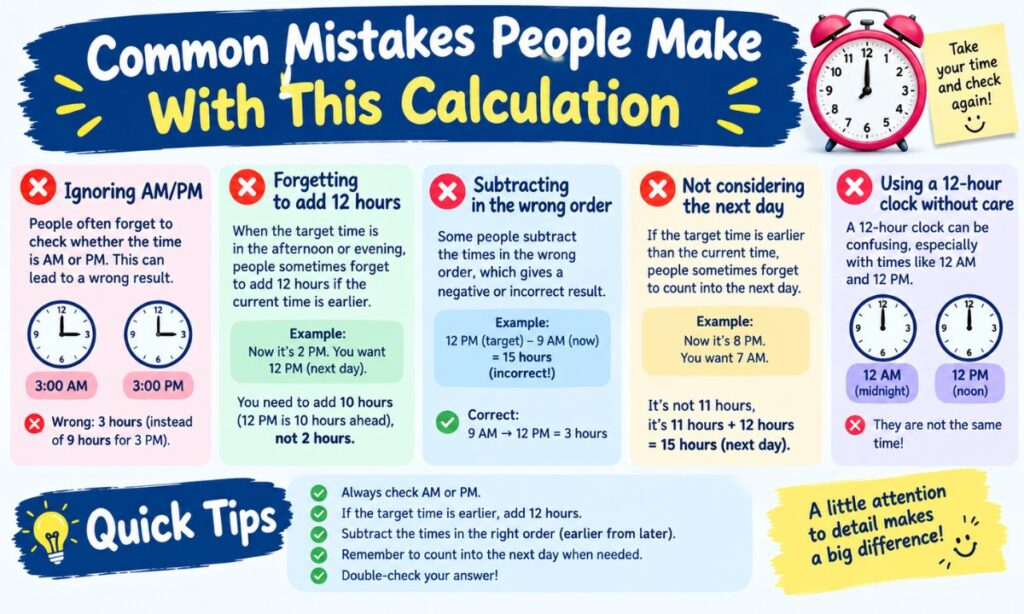
A few errors show up again and again when people try to work this out on their own.
- Confusing 12 AM with 12 PM. Midnight and noon both display as “12,” which causes people to grab the wrong reference point entirely.
- Forgetting to borrow when subtracting minutes. If the current minute value is higher than zero, straight subtraction from 12:00 without borrowing gives a negative number that doesn’t make sense.
- Mixing 12-hour and 24-hour formats mid-calculation. Switching formats halfway through the math is one of the fastest ways to land on a wrong answer.
- Assuming noon is always “close” because it’s daytime. Someone checking at 1 AM is still nearly 11 hours away from noon, even though both times fall within the same calendar day mentally.
- Ignoring time zone differences during travel. Calculating time until noon in your home zone while physically standing in a different zone produces a number that doesn’t match local clocks.
Why People Search “How Long Until 12 PM” So Often
This phrase gets searched heavily because noon functions as a natural checkpoint in daily life. It marks the halfway point of a standard workday, the typical start of lunch, and a common deadline for morning tasks.
People also search it in bursts tied to specific events: a noon deadline for submitting something, a noon flight, or a noon meeting they’re mentally counting down to. The search itself often reflects mild anticipation, whether that’s excitement for a lunch break or pressure from an approaching deadline.
Mobile searches for this phrase spike heavily between 6 AM and 10 AM, which lines up with the morning stretch when people are most actively planning the rest of their day around a noon target.
There’s a secondary pattern too. Parents searching around school drop-off time often want to know how long until their child’s noon dismissal or lunch period, while remote workers check it as an informal marker for when to start winding down a morning task list. In both cases, the search isn’t really about the number itself. It’s about pacing whatever comes next.
Related Time Calculations Worth Knowing
Once you understand the noon countdown, these related calculations use the exact same subtraction logic.
- How long until 12 AM (midnight): Uses the same borrowing method but targets the end of the day instead of the middle.
- How long until 5 PM: A common calculation for tracking the end of a standard workday.
- How long until 3:30 PM: Useful for school pickup times and mid-afternoon appointments.
- How long until 9 AM: Common among people planning their morning routine around a fixed start time.
- How many hours between two custom times: The general version of this problem, useful once you’re comfortable with the basic subtraction pattern.
A Faster Mental Shortcut
For quick mental math without paper, round your current time to the nearest 15-minute mark, calculate the rough gap to noon, then adjust by the few minutes you rounded off. This gets you a usable estimate in under five seconds, which is often all that’s needed when you’re just gauging how much morning is left.
Conclusion
The gap between right now and 12 PM changes by the second, but the method for finding it never does. Convert to 24-hour time, subtract carefully with proper borrowing, and check your answer by counting forward.
Whether you’re timing a fast, a flight, or just wondering how much of the morning is left, this simple subtraction gets you a reliable answer every time.
Frequently Asked Questions
How do I quickly calculate how long until 12 PM from any time?
Subtract your current time from 12:00 using 24-hour format, borrowing an hour when your current minutes are greater than zero.
Is 12 PM the same as noon?
Yes, 12 PM and noon refer to the exact same moment, the midpoint of the day between morning and afternoon.
How long until 12 PM if it’s currently 12 AM?
If it’s currently midnight (12 AM), you have exactly 12 hours until noon (12 PM).
Does the time until 12 PM change with time zones?
Yes, the countdown is always based on local time, so travelers need to recalculate using the current time zone rather than their home zone.
Why do people confuse 12 AM and 12 PM so often?
Both times display as “12” on a clock, and the AM/PM label is easy to overlook when reading quickly, which causes frequent mix-ups.

James Anderson is a passionate English grammar writer at GlobalMegzine, sharing simple language tips, word meanings, slang guides, and easy grammar knowledge for everyday readers.