
The time left until 1:50 depends entirely on what time it is right now. This guide breaks down the exact math, gives you ready-made tables for common start times, and shows you how to work out the gap yourself in seconds, whether you mean 1:50 AM or 1:50 PM.
Most people who type this question into a search bar are checking on something specific. Maybe a meeting starts at 1:50. Maybe a show airs then, or a flight boards, or a lunch break ends. Whatever the reason, you want a fast, accurate answer without pulling out a calculator or doing mental math under pressure.
Quick Verdict: How To Get Your Answer Right Now
If you know the current time, subtract it from 1:50 using a simple hours-and-minutes split. The general rule looks like this:
Time Remaining = Target Time (1:50) minus Current Time
If the current time is earlier in the day than 1:50, you simply count forward. If it is later, you are counting toward 1:50 the next day, which means adding 24 hours to the calculation first.
Here is a fast reference for a handful of common starting points:
| Current Time | Time Until 1:50 PM | Time Until 1:50 AM |
| 9:00 AM | 4 hours 50 minutes | 16 hours 50 minutes |
| 10:30 AM | 3 hours 20 minutes | 15 hours 20 minutes |
| 12:00 PM | 1 hour 50 minutes | 13 hours 50 minutes |
| 1:00 PM | 50 minutes | 12 hours 50 minutes |
| 1:45 PM | 5 minutes | 12 hours 5 minutes |
| 6:00 PM | 19 hours 50 minutes | 7 hours 50 minutes |
| 11:00 PM | 14 hours 50 minutes | 2 hours 50 minutes |
This table covers the most searched scenarios, but the method behind it works for any starting time you have in mind.
How To Calculate Time Until 1:50 Yourself
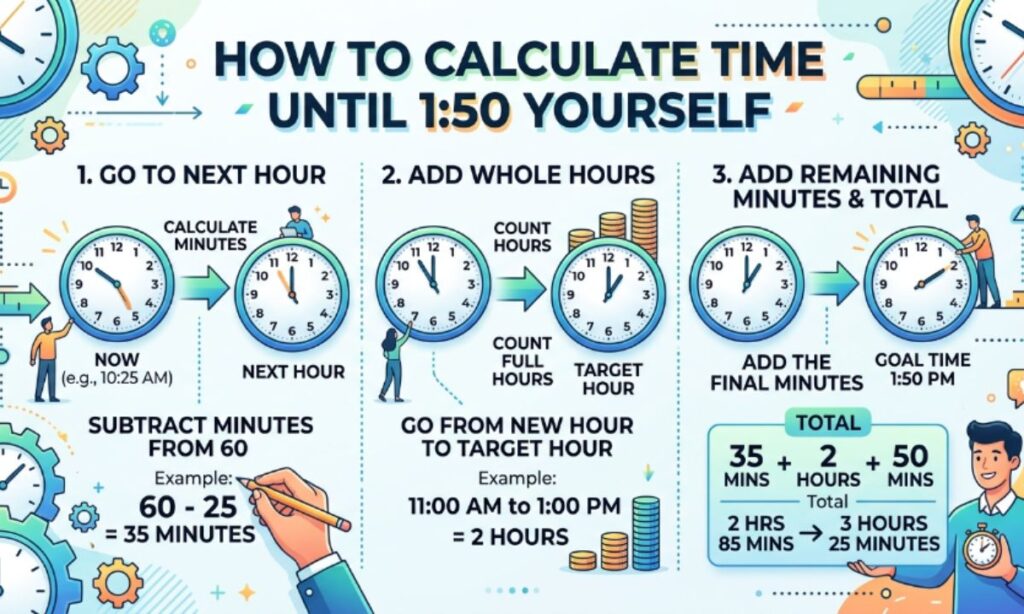
Working this out by hand is easier than it looks once you break it into three small steps.
Step 1: Convert Both Times Into Minutes
Take the current time and 1:50, then convert each into total minutes since midnight. For example, 1:50 PM equals 13 hours and 50 minutes, which is 830 minutes since midnight (13 x 60 + 50).
Step 2: Subtract Current Minutes From Target Minutes
Convert your current time the same way, then subtract. If it is 10:15 AM, that converts to 615 minutes since midnight. Subtract 615 from 830, and you get 215 minutes remaining.
Step 3: Convert The Result Back Into Hours And Minutes
Divide the remaining minutes by 60 to get full hours, then keep the leftover as minutes. 215 minutes divided by 60 gives 3 hours with 35 minutes left over, so the answer is 3 hours and 35 minutes.
Handling The Overnight Case
If your current time falls after 1:50 PM and you are counting toward 1:50 AM the next day, add 1440 minutes (24 hours) to the target time before subtracting. This keeps the math accurate instead of giving you a negative number.
Time Until 1:50 PM: Detailed Scenario Table
People checking this specific time are often tracking an early afternoon appointment, a lunch meeting wrap-up, or a scheduled call. Here is a more detailed breakdown across a full day.
| Starting Point | Hours and Minutes Remaining | Total Minutes |
| Midnight (12:00 AM) | 13 hours 50 minutes | 830 minutes |
| 6:00 AM | 7 hours 50 minutes | 470 minutes |
| 8:30 AM | 5 hours 20 minutes | 320 minutes |
| 11:00 AM | 2 hours 50 minutes | 170 minutes |
| 1:20 PM | 30 minutes | 30 minutes |
| 1:49 PM | 1 minute | 1 minute |
| 2:00 PM (already passed) | Already passed by 10 minutes | -10 minutes |
Time Until 1:50 AM: Detailed Scenario Table
Early morning searches for this time usually come from night shift workers, travelers dealing with time zones, or anyone tracking a very early flight or train departure.
| Starting Point | Hours and Minutes Remaining | Total Minutes |
| Noon (12:00 PM) | 13 hours 50 minutes | 830 minutes |
| 6:00 PM | 7 hours 50 minutes | 470 minutes |
| 9:45 PM | 4 hours 5 minutes | 245 minutes |
| 11:30 PM | 2 hours 20 minutes | 140 minutes |
| 1:00 AM | 50 minutes | 50 minutes |
| 1:48 AM | 2 minutes | 2 minutes |
Practical Real-World Examples
Numbers on a table only tell part of the story. Here are a few situations where knowing the exact countdown to 1:50 actually matters.
Catching a flight departing at 1:50 PM. If you land at the airport at 11:20 AM, you have 2 hours and 30 minutes before departure. That is enough time for check-in and security at most airports, but tight if the line is long.
A work meeting scheduled for 1:50 PM. If your previous call ends at 1:35 PM, you only have 15 minutes to grab coffee, review notes, or step outside for air before the next one starts.
A show or stream starting at 1:50 AM. If you are staying up to watch a live broadcast and it is currently 10:00 PM, you are looking at a 3 hour 50 minute wait, which is worth planning a nap around.
A medication or feeding schedule at 1:50 PM. Parents and caregivers often track small windows like this. If it is 1:15 PM, that leaves exactly 35 minutes to prepare.
Common Mistakes People Make With Time Calculations
Small errors creep in more often than you would expect, especially when people are rushing or doing the math in their head.
- Mixing up AM and PM. This is the single biggest source of confusion. A gap that should be 50 minutes can turn into a 12-hour miscalculation if you assume the wrong half of the day.
- Forgetting the 24-hour wraparound. When the target time falls earlier in the clock than the current time, people sometimes get a negative number and don’t know what it means, when really it just signals the target is tomorrow.
- Using 60-minute subtraction like it is base 10. Time doesn’t work like regular decimal subtraction. Subtracting 1:15 from 1:50 is not “35” in the way subtracting 15 from 50 is straightforward, once you cross an hour boundary the borrowing gets trickier, so converting to total minutes first avoids the trap.
- Ignoring time zones during travel. If you are calculating time until 1:50 for a flight or a call with someone in another region, the local time on your device may not match the time zone the event is actually happening in.
- Rounding too early. Rounding 47 minutes up to “about an hour” might be fine for casual planning, but for anything time-sensitive like a flight or a dose schedule, the exact minute count matters.
Why People Search “How Long Until 1:50”
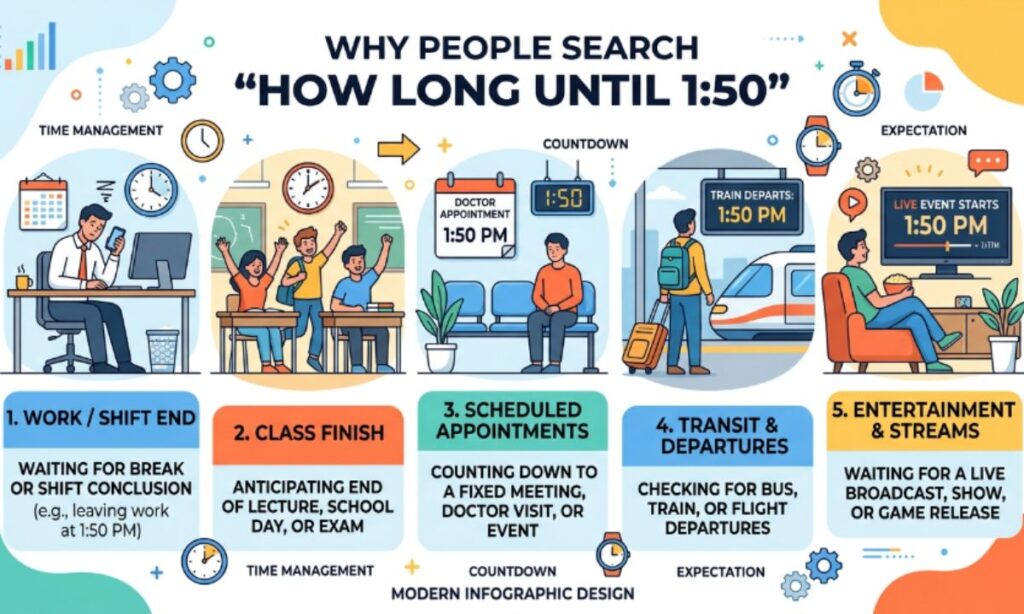
This kind of query spikes for a handful of predictable reasons, and understanding them helps explain why such a specific time draws so many searches.
- Scheduled events with hard start times. Meetings, classes, appointments, and broadcasts that begin at 1:50 create a natural need to know exactly how much time is left.
- Countdown anxiety before something important. Waiting for test results, a flight boarding call, or a job interview creates a psychological pull to check the clock repeatedly, and searching the exact countdown feels more concrete than just glancing at a phone.
- Shift work and irregular schedules. People working night shifts or rotating schedules often lose track of standard daytime cues, so they search exact times rather than relying on a general sense of “afternoon” or “evening.”
- Cooking, baking, or timed tasks. If something needs to come out of the oven or off the stove at 1:50, a fast countdown answer saves a trip to find a timer.
- Curiosity paired with convenience. Sometimes there is no deep reason at all. Typing the question into a search bar is simply faster than doing the subtraction by hand.
Related Calculations And Topics Worth Knowing
Once you understand the logic behind calculating time until 1:50, the same method applies to almost any target time you need to track.
- How long until a different specific time, such as 2:30 PM or 9:15 AM, using the identical minutes-based subtraction method described above.
- Countdown to a specific date, which follows the same subtraction logic but scales up to days, weeks, or months instead of hours and minutes.
- Time zone conversions, which matter when the “1:50” you are tracking is happening somewhere other than your current location.
- Elapsed time calculations, which flip the question around and ask how much time has passed since 1:50 rather than how much is left until it.
- Military time conversions, since 1:50 PM in 24-hour format reads as 13:50, which is useful for travel, tech schedules, and international communication.
Conclusion
Figuring out how long until 1:50 comes down to one simple habit: convert both times into total minutes, subtract, then convert back into hours and minutes.
Whether you are tracking a flight, a meeting, a show, or just watching the clock for personal reasons, the tables and steps above give you a fast, accurate way to get your answer without guesswork. Bookmark the method, and you will never need to second-guess a countdown again.
Frequently Asked Questions
How do I calculate how long until 1:50 PM from any current time?
Convert both times into minutes since midnight, subtract the current time from 830 minutes (1:50 PM), then convert the result back into hours and minutes.
Is 1:50 in the afternoon or morning?
It depends on whether it is written as 1:50 AM or 1:50 PM. AM means early morning, while PM refers to early afternoon.
What is 1:50 PM in 24-hour military time?
1:50 PM converts to 13:50 in 24-hour format, which is commonly used in travel schedules and international settings.
How many minutes are there between 12:00 PM and 1:50 PM?
There are exactly 110 minutes between noon and 1:50 PM, which equals 1 hour and 50 minutes.
Why does my countdown show a negative number?
A negative result usually means the target time has already passed for the current day, so you need to add 24 hours to calculate the time until the next occurrence.

James Anderson is a passionate English grammar writer at GlobalMegzine, sharing simple language tips, word meanings, slang guides, and easy grammar knowledge for everyday readers.