
The time left until 2:30 depends on the exact moment you’re checking, but you can work it out in seconds using the current clock time and a simple subtraction method. Below, you’ll find the direct calculation, ready-made tables for common scenarios, and a breakdown of exactly how to figure this out for yourself, whether you mean 2:30 AM or 2:30 PM, today or tomorrow.
If you landed here because you’re waiting on an appointment, a call, a flight, or just watching the clock, this guide walks through every version of the question “how long until 2:30” so you never have to do the math by hand again.
Quick Verdict: How Long Until 2:30 Right Now
The countdown to 2:30 changes constantly since it’s tied to the live clock. Here’s the simple rule:
- Take the current time.
- Subtract it from 2:30 (either AM or PM, depending on which one applies to you).
- If the current time has already passed 2:30 today, you’re counting toward 2:30 tomorrow instead.
For example, if it’s currently 11:15 AM, the time until 2:30 PM is 3 hours and 15 minutes. If it’s currently 4:45 PM, the time until 2:30 PM has already passed for the day, so you’d be counting toward 2:30 AM the next morning, roughly 9 hours and 45 minutes away.
This flexibility is exactly why a countdown to a clock time (rather than a full date) needs a bit of judgment about AM versus PM and today versus tomorrow.
Why “How Long Until 2:30” Doesn’t Have One Fixed Answer
Unlike counting down to a specific date, such as a birthday or a holiday, a countdown to a clock time resets every single day. There are two versions of 2:30 in every 24-hour period: 2:30 in the early morning and 2:30 in the afternoon. That means the answer to this question always depends on three things.
- The current time you’re checking from, down to the minute.
- Which 2:30 you mean, since AM and PM point to completely different moments.
- Whether that time has already passed today, which decides if you’re counting hours or counting toward tomorrow.
Once you lock in those three details, the math itself is straightforward subtraction.
How to Calculate the Time Until 2:30
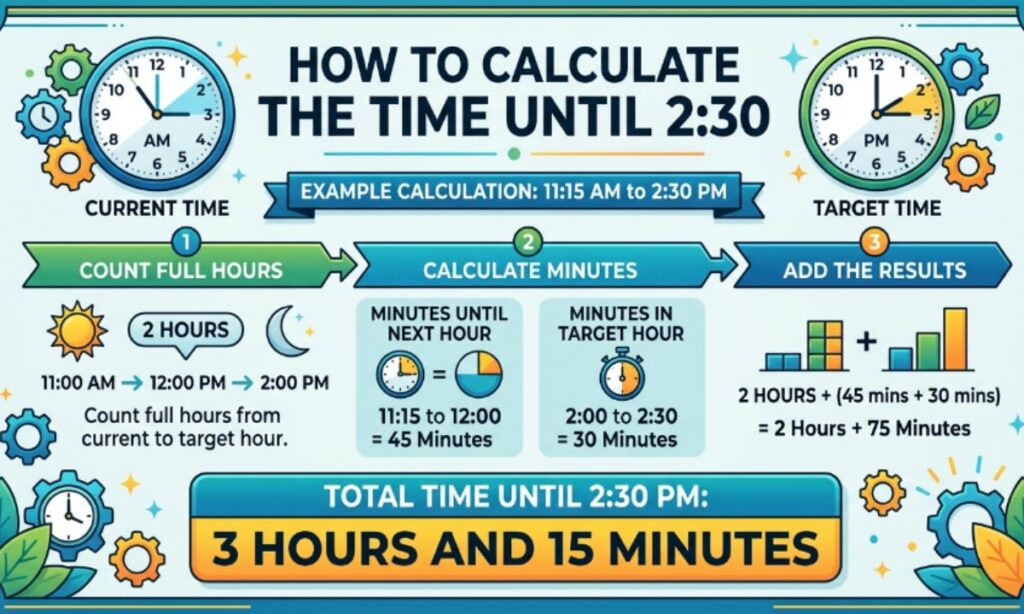
Here’s the method broken into clear steps, whether you’re doing it by hand or just want to understand what a countdown timer is doing behind the scenes.
Step 1: Confirm the Target Time
Decide if you mean 2:30 AM or 2:30 PM. This single choice changes your entire calculation, so it’s worth locking down first.
Step 2: Check the Current Time
Look at the clock right now, including the minutes. Precision matters here because being off by even five minutes will throw off your countdown.
Step 3: Compare the Two Times
If the current time is earlier than 2:30 on the same clock cycle, subtract the current time from 2:30. If the current time is later than 2:30, you’re now counting toward the next occurrence of 2:30, which falls on the following day.
Step 4: Convert to Hours and Minutes
Once you have the raw difference, express it in hours and minutes for a cleaner read. For instance, a gap of 195 minutes converts to 3 hours and 15 minutes.
Step 5: Adjust for AM/PM Confusion
Double-check that you haven’t mixed up morning and afternoon. This is the single most common error people make when counting down to a clock time.
Countdown Examples: Time Until 2:30 PM
| Current Time | Time Until 2:30 PM |
| 8:00 AM | 6 hours 30 minutes |
| 9:45 AM | 4 hours 45 minutes |
| 11:00 AM | 3 hours 30 minutes |
| 12:15 PM | 2 hours 15 minutes |
| 1:00 PM | 1 hour 30 minutes |
| 2:00 PM | 30 minutes |
| 2:29 PM | 1 minute |
Countdown Examples: Time Until 2:30 AM
| Current Time | Time Until 2:30 AM |
| 6:00 PM | 8 hours 30 minutes |
| 8:30 PM | 6 hours |
| 10:00 PM | 4 hours 30 minutes |
| 11:45 PM | 2 hours 45 minutes |
| 1:00 AM | 1 hour 30 minutes |
| 2:15 AM | 15 minutes |
Converting Minutes Into Hours and Minutes
Sometimes a countdown tool spits out a raw number of minutes, and you need to translate that into something readable. Here’s a quick reference for the most common gaps people run into when counting toward 2:30.
| Total Minutes | Hours + Minutes |
| 30 | 0 hours 30 minutes |
| 60 | 1 hour 0 minutes |
| 90 | 1 hour 30 minutes |
| 150 | 2 hours 30 minutes |
| 240 | 4 hours 0 minutes |
| 360 | 6 hours 0 minutes |
| 570 | 9 hours 30 minutes |
To do this conversion yourself, divide the total minutes by 60 to get the hour count, then take the remainder as the leftover minutes.
Real-World Scenarios Where This Question Comes Up
People search for a countdown to a specific clock time for all sorts of practical reasons, not just curiosity. A few common ones:
- Work shifts: Checking how much longer until a shift ends or a break starts, especially for jobs with a fixed 2:30 clock-out.
- School dismissal: Parents and students tracking how long until class lets out at 2:30.
- Medical appointments: Counting down to a 2:30 appointment slot to plan travel time.
- Flights and trains: Working out how long remains before a 2:30 departure or boarding call.
- Live events: Tracking the wait before a 2:30 kickoff, show start, or broadcast.
- Fasting or medication windows: Some people count hours to a specific time for intermittent fasting schedules or medication dosing.
Common Mistakes People Make With This Calculation
A few small errors trip people up more often than you’d expect when counting toward a clock time.
- Mixing up AM and PM. This is by far the most frequent mistake, since 2:30 AM and 2:30 PM are twelve hours apart.
- Forgetting the date rolls over. If it’s currently past 2:30 for the day, the next 2:30 is tomorrow, not later today.
- Rounding minutes carelessly. Treating “about 2:30” and “exactly 2:30” as the same thing can throw off tight schedules.
- Ignoring time zones. If you’re coordinating with someone in another region, 2:30 in your time zone might not be 2:30 in theirs.
- Using a 12-hour clock without labeling it. Writing down just “2:30” without AM or PM leaves room for confusion later.
Why People Search This Topic
Clock-time countdowns are one of the most common types of quick lookup online, and 2:30 specifically comes up often because it sits right in the middle of both the early afternoon and the middle of the night. It’s a natural break point for lunch schedules, mid-shift transitions, school pickup times, and overnight wake-up alarms.
People aren’t usually looking for a history lesson on time. They want a fast, accurate number they can act on immediately, which is why a direct calculation paired with clear tables tends to be more useful than a long explanation.
Related Calculations and Topics
If counting down to 2:30 was useful to you, a few related calculations tend to come up in the same context.
- How long until 3:00, useful for anyone tracking the next half-hour or full-hour mark.
- How long until midnight, a common one for New Year’s countdowns and late-shift workers.
- How many hours between two clock times, which is the general version of this same subtraction method.
- Time zone converters, for translating a 2:30 target across different regions.
- Countdown to a specific date, for events further out than today or tomorrow.
Conclusion
Figuring out how long until 2:30 comes down to one simple subtraction, as long as you’re clear on whether you mean morning or afternoon and whether that time has already passed for the day.
Once those two details are locked in, the math takes seconds, and the tables above cover most of the common starting points people search for. Bookmark this if you find yourself checking clock-time countdowns often, since the method here applies to any target time, not just 2:30.
Frequently Asked Questions
How do I calculate how long until 2:30 PM from now?
Subtract your current time from 2:30 PM. If it’s earlier in the day, the difference in hours and minutes is your answer directly.
What if it’s already past 2:30 today?
You’re then counting toward 2:30 tomorrow. Calculate the time remaining until midnight, then add 2 hours and 30 minutes.
Is 2:30 in the afternoon the same as 14:30?
Yes. In 24-hour format, 2:30 PM is written as 14:30, while 2:30 AM stays as 02:30.
Why does my countdown app show a different number than my manual calculation?
Most countdown apps use your device’s exact time down to the second, so small differences usually come from timing, not an error in the math.
Can I use this method for any target time, not just 2:30?
Yes. The same subtraction approach works for any clock time, whether you’re counting down to 5:00, 9:15, or midnight.

James Anderson is a passionate English grammar writer at GlobalMegzine, sharing simple language tips, word meanings, slang guides, and easy grammar knowledge for everyday readers.