
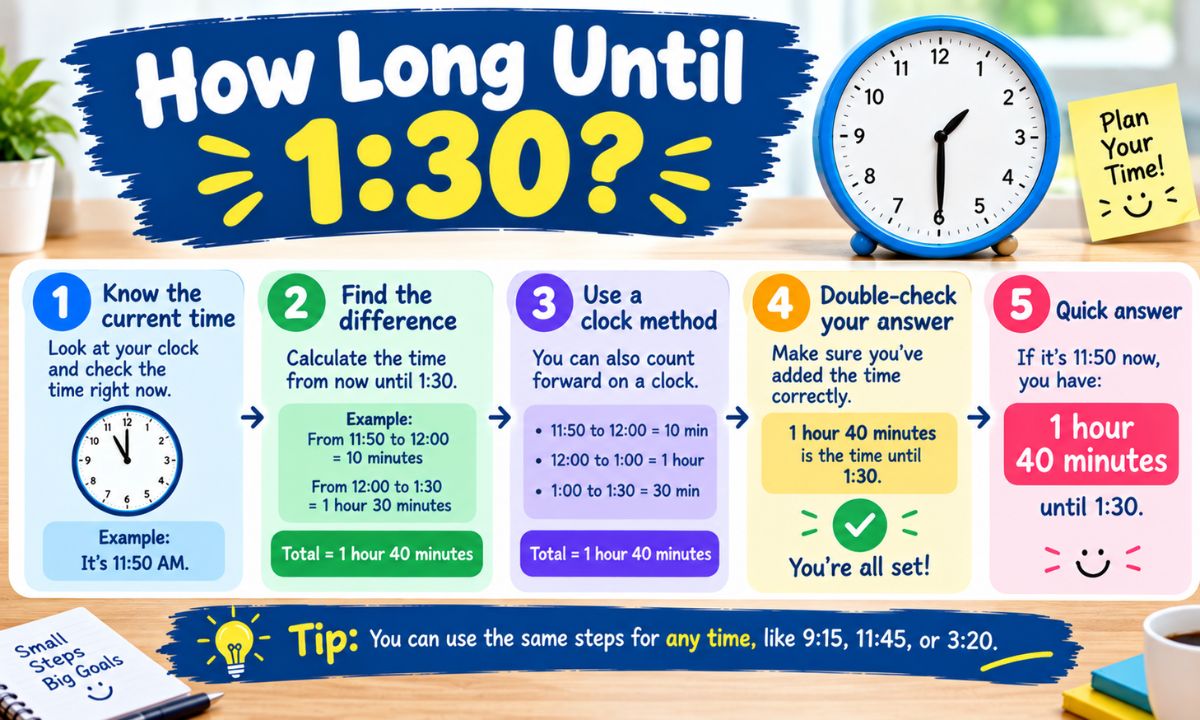
Ever caught yourself staring at the clock, trying to figure out exactly how long until 1:30? Maybe you have a meeting at 1:30 PM, a nap alarm set for 1:30 AM, or you’re just counting down the minutes until lunch break.
Whatever the reason, this guide breaks down exactly how to calculate the time remaining until 1:30, no matter what time it is right now.Time math seems simple until you’re actually doing it in your head while distracted.
Quick Answer: How Long Until 1:30?
The exact answer depends entirely on the current time when you’re asking. There are two versions of 1:30 in every 24-hour period: 1:30 AM and 1:30 PM. To get your answer, you need to know your current time first, then calculate the gap to whichever 1:30 you mean.
Here’s the general logic in plain terms:
- If it’s currently before 1:30 (AM or PM), subtract the current time from 1:30 to get the remaining time.
- If it’s currently after 1:30, you’re counting forward to the next occurrence of 1:30, which could be later today or tomorrow.
- If it’s exactly 1:30 right now, congratulations, the wait is over.
The table below shows some quick examples so you can see the pattern before diving into the full calculation method.
| Current Time | Target Time | Time Remaining |
| 12:00 PM | 1:30 PM | 1 hour 30 minutes |
| 11:45 AM | 1:30 PM | 1 hour 45 minutes |
| 1:00 PM | 1:30 PM | 30 minutes |
| 1:30 PM | 1:30 PM | 0 minutes (it’s now) |
| 2:00 PM | 1:30 PM (next day) | 23 hours 30 minutes |
| 10:00 PM | 1:30 AM (next day) | 3 hours 30 minutes |
| 12:15 AM | 1:30 AM | 1 hour 15 minutes |
How to Calculate Time Until 1:30
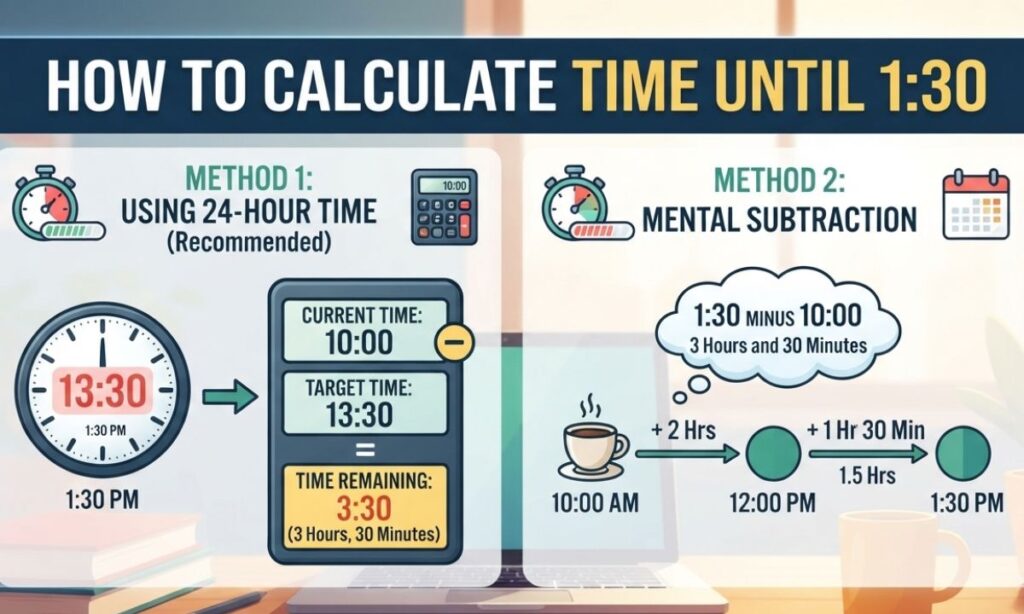
Working out the exact countdown is straightforward once you break it into small steps. Here’s the method that works every time, regardless of what the current time happens to be.
Step 1: Identify Your Current Time and AM/PM
Before anything else, write down the exact time right now, including whether it’s morning or afternoon. This sounds obvious, but a huge share of time-math mistakes happen because someone mixes up AM and PM partway through the calculation.
Step 2: Decide Which 1:30 You Mean
There are two 1:30s in a day. If you’re asking about a lunch meeting, you almost certainly mean 1:30 PM. If you’re asking about an early morning alarm, you mean 1:30 AM. Pin this down before doing any math.
Step 3: Subtract Hours First, Then Minutes
Convert both times to a 24-hour format if it helps you avoid confusion. Then subtract the hour portion first, and adjust the minutes separately. For example, going from 11:15 AM to 1:30 PM: the hour gap from 11 to 1 is 2 hours, then adjust for the minutes difference between :15 and :30, which adds 15 more minutes. Total: 2 hours 15 minutes.
Step 4: Borrow an Hour If Minutes Go Negative
If your current minutes are higher than 30 (the minute value in 1:30), you’ll need to borrow an hour. For instance, from 12:45 PM to 1:30 PM, you can’t do :45 to :30 cleanly, so borrow: 45 minutes to the next full hour (1:00 PM) is 15 minutes, then add the remaining 30 minutes from 1:00 to 1:30. Total: 45 minutes.
Step 5: Roll Over to the Next Day If Needed
If the current time is already past 1:30 for the AM/PM period you’re targeting, add 24 hours worth of time and calculate from there. This is the step people forget most often, especially late at night when counting toward an early morning target.
Common Mistakes and Misconceptions
A lot of confusion around time calculations comes down to a handful of repeat offenders. Here’s what trips people up most.
- Mixing up AM and PM: Forgetting whether the target is morning or afternoon throws off the whole calculation, sometimes by a full 12 hours.
- Forgetting to borrow the hour: When the current minute count is higher than the target minute count, skipping the borrowing step gives a negative or nonsensical result.
- Ignoring the day rollover: If it’s 9:00 PM and you’re counting to 1:30 AM, forgetting that this crosses into the next calendar day leads to wildly wrong answers.
- Assuming a 12-hour clock without checking: Some digital displays default to 24-hour format, so 13:30 actually means 1:30 PM, not a typo.
- Rounding too early: Rounding minutes before finishing the subtraction can throw off the final total by several minutes, which matters if you’re timing something precise like a phone call or a bus departure.
Why People Search “How Long Until 1:30”
This search shows up for a surprising range of reasons, and most of them are pretty practical.
- Meetings and appointments: A lot of workplace schedules default to half-hour blocks, and 1:30 PM lands right after the typical lunch hour, making it a common meeting slot.
- School and class schedules: Many school days include a 1:30 dismissal time or a period change around that mark.
- Medication or dosage timing: People tracking medication schedules often need to know exactly how many minutes remain until their next dose window opens.
- Sleep and nap tracking: 1:30 AM shows up often for people managing irregular sleep schedules, shift work, or parents tracking a baby’s feeding times.
- Event countdowns: Livestreams, webinars, and ticketed events frequently start at 1:30, prompting last-minute countdown checks.
- Cooking and baking timers: Recipes with long prep windows sometimes need a finish time calculated backward or forward from a target like 1:30.
Time Zone Considerations
If you’re coordinating with someone in a different time zone, “1:30” doesn’t mean the same moment for both of you. A meeting scheduled for 1:30 PM Eastern Time is 10:30 AM Pacific Time and 6:30 PM in London during standard time periods.
Always confirm which time zone the 1:30 refers to before doing your countdown math, especially for virtual meetings, international calls, or online events. A quick mismatch here causes more missed appointments than almost any other scheduling error.
Real-World Example Scenarios
Seeing the calculation applied to everyday situations makes the method easier to remember. Here are a few common ones.
| Scenario | Current Time | Target | Calculation Result |
| Lunch meeting reminder | 12:50 PM | 1:30 PM | 40 minutes |
| Late-night alarm check | 11:10 PM | 1:30 AM | 2 hours 20 minutes |
| Webinar countdown | 1:05 PM | 1:30 PM | 25 minutes |
| School pickup time | 1:00 PM | 1:30 PM | 30 minutes |
| Overnight shift end | 10:45 PM | 1:30 AM | 2 hours 45 minutes |
| Medication dose window | 1:32 PM | 1:30 PM (already passed) | 2 minutes ago |
Related Calculations and Topics
Once you’ve got the hang of counting toward 1:30, the same method applies to almost any target time. A few related searches people often look up alongside this one include figuring out the gap to other common half-hour marks like 2:30 or 3:30, converting between 12-hour and 24-hour clock formats, and calculating elapsed time between two arbitrary points rather than counting toward a fixed target.
Understanding how minutes and hours interact across the clock face also helps with broader tasks like estimating travel time, planning workout intervals, or setting multi-step cooking timers where several dishes need to finish around the same target time.
Conclusion
Figuring out how long until 1:30 comes down to knowing your current time, confirming whether you mean AM or PM, and subtracting carefully with attention to borrowing hours and rolling over past midnight when needed. Once you walk through the steps a couple of times, the math becomes second nature, and you won’t need to double check it every time a countdown question pops up.
Whether you’re racing to make a meeting, tracking a nap schedule, or just curious, the method stays the same. Identify the current time, lock in your target, and work the subtraction one step at a time.
Frequently Asked Questions
How do I know if 1:30 means AM or PM?
Context usually makes it clear, such as a work meeting meaning PM or an alarm clock meaning AM. When in doubt, check the original schedule or reminder for confirmation.
What if it’s already past 1:30 today?
You’re counting toward the next occurrence of 1:30, which will be roughly 24 hours from the last one, adjusted for your current time.
Does daylight saving time affect this calculation?
Only on the two days per year when clocks shift, and only if the countdown period spans that exact change. On any normal day, standard subtraction works fine.
Why do I need to borrow an hour sometimes?
Borrowing is needed when the current minute value is higher than the target minute value, since you can’t subtract a larger number of minutes from a smaller one without adjusting the hour.
Can I use this method for any target time, not just 1:30?
Yes, the same subtraction and borrowing steps apply to any time calculation, whether you’re counting toward 2:15, 9:45, or any other clock time.

James Anderson is a passionate English grammar writer at GlobalMegzine, sharing simple language tips, word meanings, slang guides, and easy grammar knowledge for everyday readers.