
Do you ever find yourself checking the clock and wondering exactly how long until 3:35? Whether you are waiting for a meeting, tracking a break, or just curious about the time left in your day, knowing the exact countdown can be helpful. This simple guide breaks it down for you in seconds.
Calculating the time until 3:35 does not have to be complicated. All you need is the current time and a few quick steps to get your answer. In this guide, we will show you an easy method to calculate it yourself, plus a quick reference to make things even faster.
Quick Answer
The exact countdown to 3:35 depends entirely on what time it is right now, since “3:35” happens twice a day, once in the morning and once in the afternoon.
Here’s the fast version:
- If it’s currently before 3:35 AM: subtract your current time from 3:35 AM.
- If it’s currently between 3:35 AM and 3:35 PM: subtract your current time from 3:35 PM.
- If it’s currently after 3:35 PM: you’re counting toward 3:35 AM the next day.
To get your personal answer right now, check your device clock, then use the step-by-step method below. It takes about ten seconds once you know the trick.
Why “How Long Until 3:35” Doesn’t Have One Fixed Answer
A lot of people search this phrase expecting a single fixed number, but time-until questions are always relative to the present moment. Since you could be reading this at 9:12 AM or 11:47 PM, the gap to 3:35 changes completely depending on when you check.
That’s actually the whole point of a countdown calculation. It’s not a fact you memorize, it’s a formula you apply. Once you understand the formula, you can answer this for any target time, not just 3:35.
How to Calculate Time Until 3:35
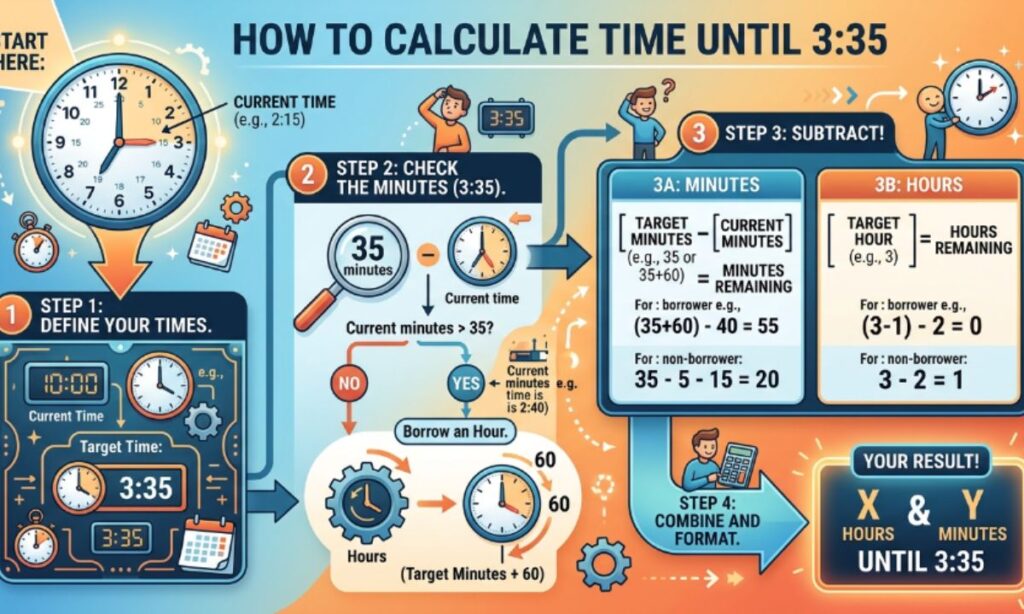
Follow these steps and you’ll never need a calculator app again.
Step 1: Note Your Current Time
Look at your clock and write down the exact hour and minute, including whether it’s AM or PM.
Step 2: Pick the Correct 3:35 Target
Decide whether you’re counting toward 3:35 AM or 3:35 PM. If someone told you “the meeting starts at 3:35” during a normal workday, they almost certainly mean 3:35 PM.
Step 3: Convert Both Times to 24-Hour Format
This removes AM/PM confusion entirely.
- 3:35 AM becomes 03:35
- 3:35 PM becomes 15:35
Convert your current time the same way. For example, 10:20 PM becomes 22:20.
Step 4: Subtract Hours First, Then Minutes
Subtract your current hour from the target hour, then do the same for minutes. If the minutes come out negative, borrow an hour (60 minutes) from the hour column.
Example: Current time is 1:10 PM (13:10), target is 3:35 PM (15:35).
- Hours: 15 – 13 = 2
- Minutes: 35 – 10 = 25
- Result: 2 hours and 25 minutes until 3:35 PM
Step 5: Adjust for Overnight Countdowns
If your current time is after 3:35 PM, you’re counting to the next occurrence, which is 3:35 AM the following day. Add 24 hours to the target time before subtracting.
Time-Until Examples for 3:35 PM
Here’s a table of common starting points so you can see the pattern in action.
| Current Time | Time Until 3:35 PM |
| 8:00 AM | 7 hours 35 minutes |
| 9:15 AM | 6 hours 20 minutes |
| 11:45 AM | 3 hours 50 minutes |
| 1:00 PM | 2 hours 35 minutes |
| 2:20 PM | 1 hour 15 minutes |
| 3:00 PM | 35 minutes |
| 3:30 PM | 5 minutes |
| 3:35 PM | 0 minutes (it’s now) |
Time-Until Examples for 3:35 AM
If your target is the early morning slot instead, here’s the breakdown.
| Current Time | Time Until 3:35 AM |
| 6:00 PM (prev day) | 9 hours 35 minutes |
| 9:00 PM (prev day) | 6 hours 35 minutes |
| 11:50 PM (prev day) | 3 hours 45 minutes |
| 1:15 AM | 2 hours 20 minutes |
| 2:50 AM | 45 minutes |
| 3:20 AM | 15 minutes |
| 3:35 AM | 0 minutes (it’s now) |
Converting the Countdown into Other Units
Sometimes hours and minutes aren’t the most useful format. Here’s how to reframe the same span of time depending on what you need it for.
Minutes Only
Multiply the hour count by 60, then add the leftover minutes. A gap of 2 hours 25 minutes becomes (2 x 60) + 25 = 145 minutes total.
Seconds Only
Take your total minutes and multiply by 60. That same 145-minute gap equals 8,700 seconds. This matters more than people expect when you’re timing something short, like a livestream countdown or a cooking step.
Decimal Hours
Divide the minute portion by 60 and add it to the hour count. Twenty-five minutes divided by 60 is roughly 0.42, so 2 hours 25 minutes becomes approximately 2.42 hours. This format is common in billing, payroll, and scheduling software.
Fraction of a Day
Divide your total minutes by 1,440 (the number of minutes in a full day). A 145-minute gap is about 0.10, or roughly one-tenth of a day.
| Format | 2h 25m Converted |
| Total Minutes | 145 minutes |
| Total Seconds | 8,700 seconds |
| Decimal Hours | 2.42 hours |
| Fraction of Day | 0.10 (about 10%) |
Real-World Scenarios Where This Calculation Matters
People search “how long until 3:35” for reasons that are more practical than abstract. A few common ones:
Catching a flight or train. If boarding closes at 3:35 PM and you’re stuck in traffic checking the clock every few minutes, knowing the exact remaining window helps you decide whether to push harder or accept you’ll miss it.
Medication or dosage timing. Some prescriptions need to be taken at set intervals. If your next dose lines up with 3:35, working out the gap keeps you on schedule without guessing.
Live events and broadcasts. A stream, sports match, or webinar starting at 3:35 often has people refreshing a countdown in their head. Doing the math once settles it.
Shift changes and appointments. Retail workers, call center staff, and anyone with a fixed shift boundary at 3:35 uses this kind of calculation constantly, usually without thinking about it as “math” at all.
School and exam timing. Students tracking how long is left before a class or exam period ending at 3:35 use the same subtraction method, just with higher stakes attached.
Common Mistakes People Make With Time Calculations
A few errors show up again and again when people try to do this in their head.
- Mixing up AM and PM. This is the single biggest source of wrong answers. Always double-check which 3:35 you actually mean before you start subtracting.
- Forgetting to borrow when minutes go negative. If you’re subtracting 50 minutes from 35 minutes, you can’t just write “-15.” You need to borrow an hour and convert it to 60 minutes first.
- Ignoring the overnight rollover. People often forget that once you pass 3:35 PM, the next 3:35 isn’t later today, it’s tomorrow morning.
- Rounding too early. If you round 24 minutes up to 25 partway through a calculation, small errors stack up. Keep exact numbers until the final step.
- Assuming a 12-hour clock and a 24-hour clock behave the same way. Converting to 24-hour format first removes almost all AM/PM confusion, so it’s worth the extra ten seconds.
Why People Search This Topic
Countdown searches like this spike for a reason: people want certainty over a small window of time without opening a full calendar app or doing mental math under pressure. It’s the same instinct behind checking “how many days until Friday” or “what time is it in London right now.” These aren’t complicated questions, but they’re the kind of thing your brain doesn’t want to calculate when you’re rushed, stressed, or just tired.
There’s also a habit factor. Once someone gets used to typing a time question into a search bar instead of doing the subtraction themselves, they keep doing it, even for calculations that only take a few seconds by hand.
Related Calculations Worth Knowing
If this guide was useful, a few nearby calculations use the exact same logic:
- How long until a specific hour (like 4:00 PM or 9:00 AM), which skips the minute-borrowing step entirely and is the easiest version of this calculation.
- How many hours between two clock times, useful for tracking total elapsed time rather than a countdown to a future point.
- Time zone conversions, which layer an extra step on top of this same subtraction method, since you first convert one clock time into another zone before comparing.
- Countdown to a date rather than a time, which swaps hours and minutes for days and months but follows the same borrow-and-subtract structure.
Conclusion
Figuring out how long until 3:35 isn’t really about that specific number. It’s about knowing a quick, repeatable method: convert to 24-hour time, subtract hours, subtract minutes, borrow when needed, and adjust for overnight rollovers.
Once that process is second nature, you can answer any “how long until” question in seconds, whether the target is 3:35, midnight, or any other time on the clock.
Frequently Asked Questions
How do I know if 3:35 means AM or PM?
Context usually makes it obvious. Work schedules, meetings, and daytime events almost always mean 3:35 PM, while overnight or early-morning references mean 3:35 AM.
What if the current time is exactly 3:35?
Then the countdown is zero. You’ve reached the target moment, so there’s nothing left to calculate.
How many minutes are in the gap between 1:00 PM and 3:35 PM?
That gap is 2 hours and 35 minutes, which equals 155 minutes total when converted.
Does this calculation change across time zones?
The subtraction method stays the same, but you need to convert both times into the same time zone first before comparing them.
Can I use this method for any target time, not just 3:35?
Yes. Swap 3:35 for whatever hour and minute you’re counting toward, and the same convert-then-subtract steps apply every time.

James Anderson is a passionate English grammar writer at GlobalMegzine, sharing simple language tips, word meanings, slang guides, and easy grammar knowledge for everyday readers.