
If you landed here typing “how long until 2:10” into a search bar, you probably need a number right now, not a history lesson on clocks. Maybe you’re timing a meeting that starts at 2:10, catching a train, or just curious how much of the afternoon is left.
Whatever the reason, this guide gives you the exact method to work it out yourself in seconds, plus tables and examples so you never have to do the math twice.The tricky part with a question like this is that “2:10” could mean 2:10 AM or 2:10 PM, and the answer changes completely depending on what time it is right now when you ask.
Quick Answer
To find how long until 2:10, subtract your current time from 2:10 (either AM or PM, depending on which one you mean).
- If it’s currently before 2:10 today, subtract your current time from 2:10 today.
- If it’s currently after 2:10 today, subtract your current time from 2:10 tomorrow, meaning you add the remaining hours until midnight plus the hours from midnight to 2:10.
Below is a simple table showing this logic in action for a few sample current times.
| Current Time | Target Time | Time Remaining |
| 1:00 PM | 2:10 PM | 1 hour 10 minutes |
| 12:45 PM | 2:10 PM | 1 hour 25 minutes |
| 2:05 PM | 2:10 PM | 5 minutes |
| 2:15 PM | 2:10 PM (next occurrence, tomorrow) | 23 hours 55 minutes |
| 9:30 AM | 2:10 PM | 4 hours 40 minutes |
| 11:50 PM | 2:10 AM (next day) | 2 hours 20 minutes |
Once you know your current time, find the row closest to it and adjust slightly, or use the step-by-step method below for an exact figure.
How to Calculate the Time Until 2:10 Yourself
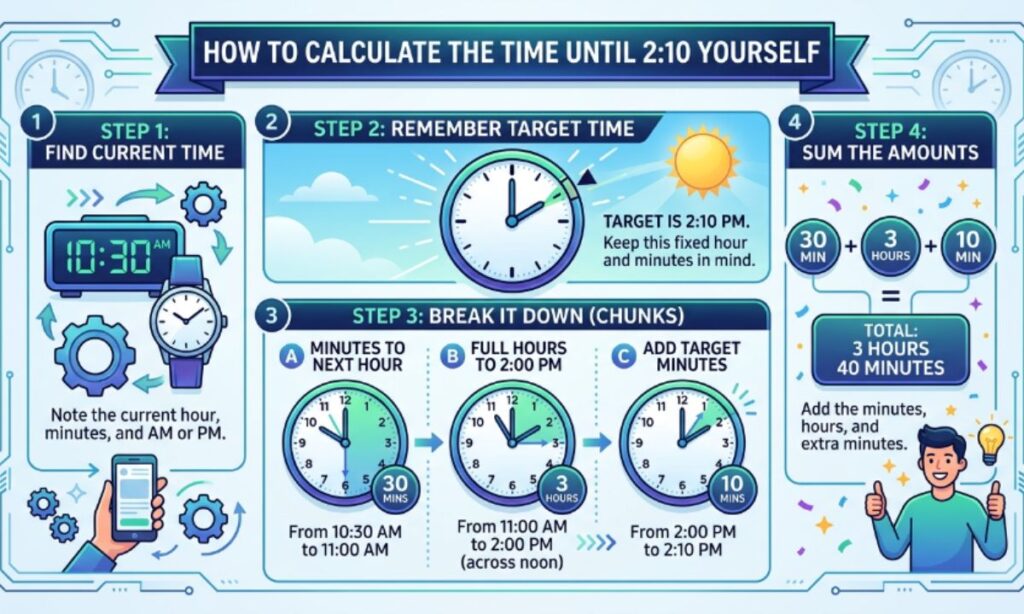
Working this out by hand is genuinely simple once you break it into three small steps. Most people overcomplicate it by trying to do everything in their head at once.
Step 1: Confirm Which 2:10 You Mean
Decide if you’re counting toward 2:10 AM or 2:10 PM. This matters more than people expect, since mixing them up can throw your answer off by twelve hours. If someone says “meet me at 2:10” without specifying AM or PM, context usually makes it obvious (a lunch meeting is not happening at 2:10 AM), but always double check when it’s ambiguous.
Step 2: Convert Both Times to Minutes Since Midnight
This removes the confusion of hours and minutes mixing together. Multiply the hour by 60, then add the minutes.
For example, if it’s currently 12:45 PM, that’s 12 hours and 45 minutes into the day. Since it’s PM, add 12 to the hour for a 24-hour format: 12 + 12 = 24, but since 12 PM is actually hour 12 in 24-hour time, we keep it as 12. So 12:45 PM equals 765 minutes since midnight (12 x 60 + 45).
2:10 PM in 24-hour time is 14:10, which equals 850 minutes since midnight (14 x 60 + 10).
Step 3: Subtract to Find the Difference
Subtract the current time in minutes from the target time in minutes.
850 minus 765 equals 85 minutes, which converts to 1 hour and 25 minutes. That matches the table above, confirming the method works.
If the result is negative, it means the target time has already passed today, so add 1440 (the total minutes in a day) to get the time remaining until 2:10 tomorrow.
Worked Examples for Different Scenarios
Seeing a few different situations side by side makes the pattern click faster than reading formulas alone.
| Scenario | Current Time | Steps Since Midnight | Target Since Midnight | Difference | Result |
| Morning check | 8:00 AM | 480 min | 850 min (2:10 PM) | 370 min | 6 hours 10 minutes |
| Just past noon | 12:10 PM | 730 min | 850 min | 120 min | 2 hours |
| Right before target | 2:09 PM | 849 min | 850 min | 1 min | 1 minute |
| Right after target | 2:11 PM | 851 min | 850 min (tomorrow: 850 + 1440) | 1439 min | 23 hours 59 minutes |
| Late night, AM target | 10:00 PM | 1320 min | 130 min (2:10 AM, add 1440) | 250 min | 4 hours 10 minutes |
Notice how the “late night” example needed the 1440-minute adjustment because 2:10 AM technically falls on the next calendar day when you’re counting from 10:00 PM.
Breaking the Result Into Different Units
Once you have the raw minutes remaining, it helps to see that number expressed a few different ways depending on what you actually need it for. Someone setting a kitchen timer wants seconds. Someone planning their afternoon wants hours and minutes. A developer coding a countdown widget might want the whole thing in raw seconds for a script.
Here is how a single result, say 85 minutes, breaks down across common formats.
| Format | Value |
| Total minutes | 85 minutes |
| Hours and minutes | 1 hour 25 minutes |
| Total seconds | 5,100 seconds |
| Fraction of a day | About 5.9 percent of a 24-hour day |
| Fraction of an hour | 1.42 hours |
This kind of breakdown is especially useful if you’re building a countdown timer, writing a script, or just want a gut sense of how much of your day is actually left before that 2:10 mark hits.
Using a Countdown for Planning, Not Just Curiosity
Knowing the exact time remaining is one thing. Using it well is another. If you have 1 hour and 25 minutes until 2:10, that number becomes far more useful once you map it against what you actually need to get done first.
A few practical ways people use this kind of countdown in daily life:
- Buffer time for travel. If a meeting starts at 2:10 and you need 20 minutes to get there, your real deadline to leave is roughly 1:50, not 2:10 itself.
- Task batching before a hard stop. Knowing you have exactly 85 minutes left lets you slot in two 30-minute tasks and a 15-minute break, rather than guessing and running short.
- Timer-based cooking or baking. If a recipe needs to finish exactly at 2:10, working backward from that number tells you precisely when to start prepping.
- Screen time or break tracking. Some people use a fixed target time like 2:10 as a personal checkpoint to step away from a screen or take a short walk.
Common Mistakes and Misconceptions
A few small errors trip people up constantly with time math like this. Here’s what to watch for.
- Mixing up AM and PM. This is the single biggest source of wrong answers, since a twelve-hour error compounds fast if you’re planning around it.
- Forgetting the next-day rollover. If the current time is already past 2:10, people often subtract and get a negative number, then panic instead of simply adding 24 hours worth of minutes.
- Ignoring time zones. If you’re coordinating with someone in a different zone, “2:10” in their location is not the same moment as “2:10” in yours. Always clarify whose clock you’re using.
- Rounding too early. Rounding minutes before finishing the subtraction can throw off the final answer by a minute or two, which matters if you’re timing something precise like a broadcast or a scheduled call.
- Assuming a 12-hour clock works the same as 24-hour math. Converting to 24-hour time first, as shown in Step 2 above, avoids almost every AM/PM mistake in one move.
Why People Search “How Long Until 2:10”
This question shows up more often than you’d think, and usually for one of a handful of practical reasons.
- Scheduled events. A meeting, class, appointment, or flight departure set for 2:10 is the most common trigger for this search.
- Countdown curiosity. Some people just like knowing exactly how much time is left in a segment of their day, especially during a workday or before a specific task.
- Cooking or timers. If something needs to finish at 2:10 and it’s currently earlier, people search this to double check their timer math instead of trusting a phone app.
- Media and broadcasts. Live events, sports broadcasts, or scheduled TV programming starting at 2:10 sends a steady stream of searches right before the time hits.
- Coordinating across time zones. Someone scheduling a call at “2:10 their time” often searches this exact phrase to translate it into their own local countdown.
Related Calculations and Topics
If this kind of time math is useful to you, a few related calculations follow the exact same logic and are worth knowing.
- How long until a specific hour on the half hour, like 2:30 or 3:30. Same subtraction method, just swap the target minutes.
- How long until midnight. Useful for deadline tracking, since midnight is always 1440 minutes since the start of the day.
- Converting between 12-hour and 24-hour time. This skill underpins almost every time calculation and is worth memorizing once.
- Calculating elapsed time between two events. The same minutes-since-midnight trick works in reverse to measure how much time has passed rather than how much is left.
- Time zone conversion basics. Since a fixed clock time means different things in different zones, learning the offset between your zone and another saves confusion on shared schedules.
Conclusion
Figuring out how long until 2:10 comes down to one simple habit: convert both times into minutes since midnight, subtract, and adjust for a rollover if the target has already passed.
Once that method is second nature, you can apply it to any target time, not just 2:10, and skip the guesswork entirely. Keep the AM and PM distinction in mind, watch for time zone differences if you’re coordinating with someone else, and you’ll get a reliable answer every single time.
FAQs
How do I know if 2:10 means AM or PM?
Context usually tells you, since 2:10 AM is late night and 2:10 PM is mid-afternoon. If it’s unclear, ask directly or check the schedule source.
What if it’s already past 2:10 today?
Calculate the time remaining until 2:10 tomorrow instead, by adding 24 hours worth of minutes to your subtraction.
Does the answer change based on time zones?
Yes. A countdown to 2:10 in one time zone is a different countdown in another, so always confirm whose local time is being used.
Can I use this method for any target time, not just 2:10?
Yes. The minutes-since-midnight subtraction method works for any target hour and minute, not just this one.
Why does converting to 24-hour time make this easier?
It removes the AM and PM guesswork entirely, since every hour of the day gets its own unique number between 0 and 23, avoiding the twelve-hour mix-up that causes most errors.

James Anderson is a passionate English grammar writer at GlobalMegzine, sharing simple language tips, word meanings, slang guides, and easy grammar knowledge for everyday readers.