
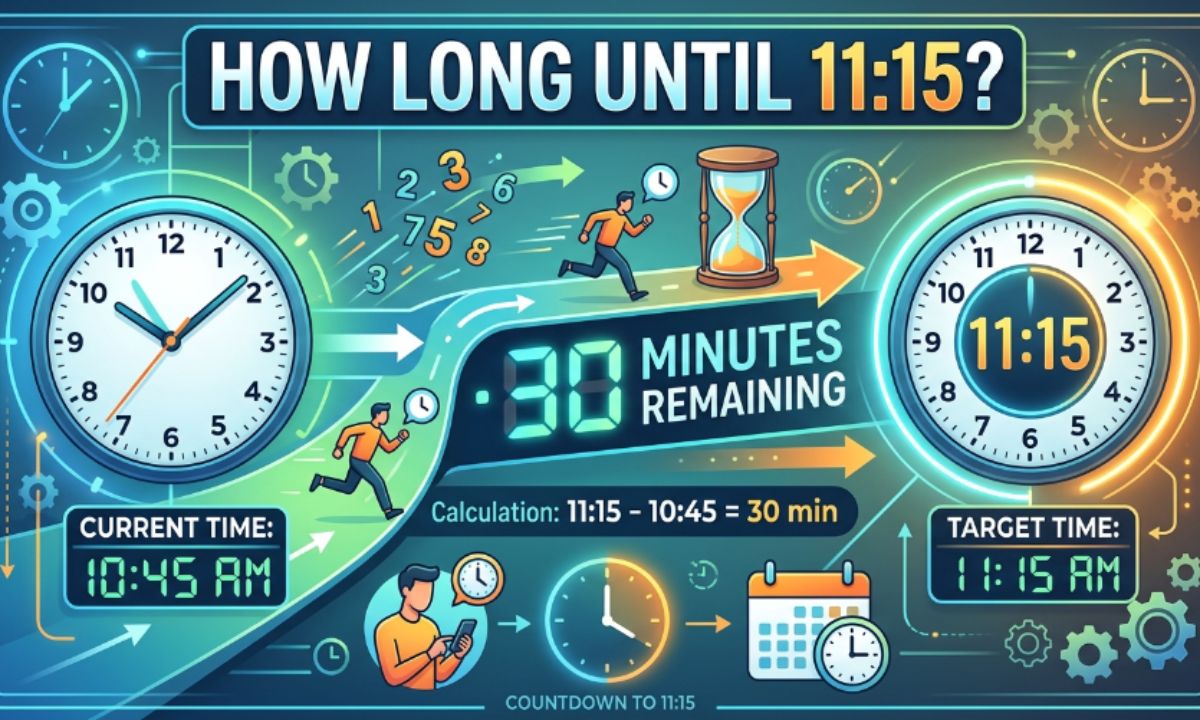
Checking the clock and wondering how long until 11:15 is more common than you think. Maybe you have a meeting, a class, or a show starting at that time. Instead of doing the math in your head, you want a quick and clear answer.
This guide gives you the fastest way to find out how much time is left until 11:15. You will also learn simple tricks to calculate it yourself, so you never have to guess again.
Quick Answer
To know how long until 11:15, subtract the current time from 11:15 using the 24-hour clock for accuracy. If it’s currently 9:45 AM, you’re 1 hour and 30 minutes away from 11:15 AM. If it’s 3:00 PM, you’re looking at roughly 20 hours and 15 minutes until 11:15 AM the next day, or about 8 hours and 15 minutes if you mean 11:15 PM.
The trick is always confirming whether you’re counting toward the morning or the evening version of 11:15, since that single detail changes the whole calculation.
Why the AM/PM Detail Matters So Much
A clock only shows 12 hours, but a full day has 24. That means 11:15 shows up twice every single day. People searching this phrase are usually in one of these situations:
- Checking a countdown to a specific appointment, call, or event that lands at 11:15 in the morning
- Tracking how long until a late-morning deadline or class starts
- Counting down to something scheduled for 11:15 at night, like a flight, a shift, or a livestream
Because the search itself doesn’t specify AM or PM, this guide covers both, with tables you can scan depending on which one applies to you.
How to Calculate Time Until 11:15 AM
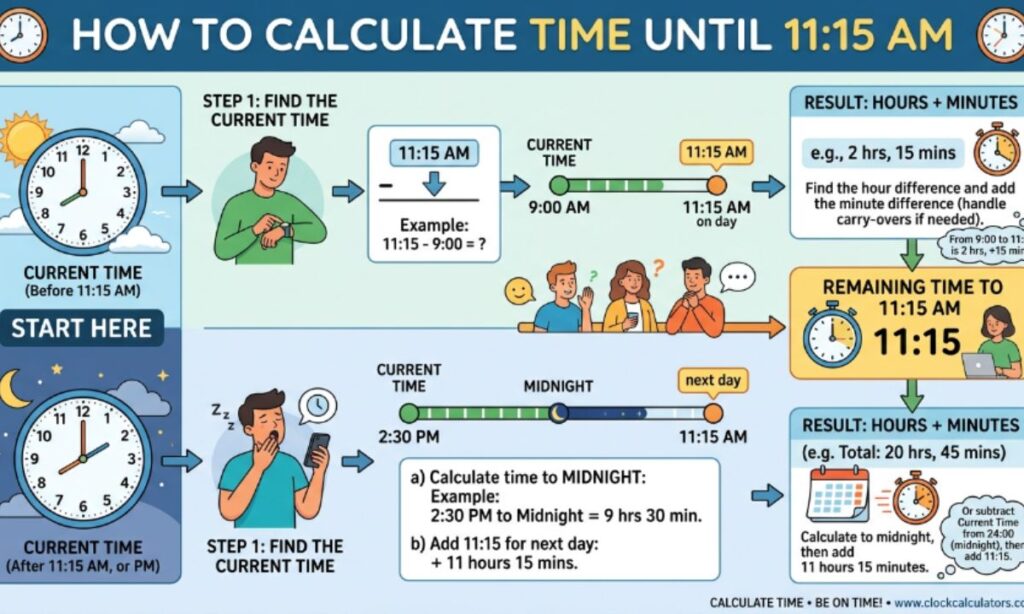
Here’s the step-by-step method, whether you’re doing it by hand or just want to understand what a countdown timer is doing behind the scenes.
Step 1: Note the Current Time
Grab the exact current time down to the minute. Precision matters here, since rounding to the nearest five minutes can throw off your total by several minutes over a longer countdown.
Step 2: Convert Everything to Minutes Past Midnight
This is the part most people skip, and it’s the part that removes all the guesswork. Convert both the current time and 11:15 AM into minutes since midnight. For 11:15 AM, that’s 11 hours times 60, plus 15 minutes, which equals 675 minutes.
Step 3: Subtract and Convert Back
Subtract your current time in minutes from 675. If the number is negative, add 1440 (the number of minutes in a full day) to account for the fact that 11:15 AM has already passed and you’re now counting toward tomorrow’s occurrence. Divide the result by 60 to get hours, and keep the remainder as minutes.
Example Calculations
| Current Time | Minutes Past Midnight | Time Until 11:15 AM |
| 6:00 AM | 360 | 5 hours 15 minutes |
| 8:30 AM | 510 | 2 hours 45 minutes |
| 10:50 AM | 650 | 25 minutes |
| 11:15 AM | 675 | 0 minutes (it’s happening now) |
| 1:00 PM | 780 | 22 hours 15 minutes (next day) |
| 9:00 PM | 1260 | 14 hours 15 minutes (next day) |
How to Calculate Time Until 11:15 PM
The same logic applies here, just with a different target number. 11:15 PM sits at the 23rd hour on the 24-hour clock, so in minutes past midnight, it lands at 1395 minutes (23 times 60, plus 15).
Example Calculations
| Current Time | Minutes Past Midnight | Time Until 11:15 PM |
| 8:00 AM | 480 | 15 hours 15 minutes |
| 12:00 PM (noon) | 720 | 11 hours 15 minutes |
| 5:30 PM | 1050 | 5 hours 45 minutes |
| 9:45 PM | 1305 | 1 hour 30 minutes |
| 11:00 PM | 1380 | 15 minutes |
| 11:20 PM | 1400 | 22 hours 55 minutes (next day) |
A Shortcut Formula You Can Use Anywhere
If tables and minute conversions feel like overkill, here’s a shortened version you can do in your head for most cases.
- Find the difference in hours between your current hour and 11 (for AM) or 23 (for PM, using 24-hour time)
- Adjust for minutes by comparing your current minute to 15
- If your current minute is higher than 15, subtract 1 from the hour difference and add the leftover minutes to reach the next hour, then add 15
This shortcut works well for casual estimates, though the minutes-past-midnight method is more reliable when you need an exact figure for something like a scheduled call or a countdown app.
Common Mistakes People Make With This Kind of Time Math
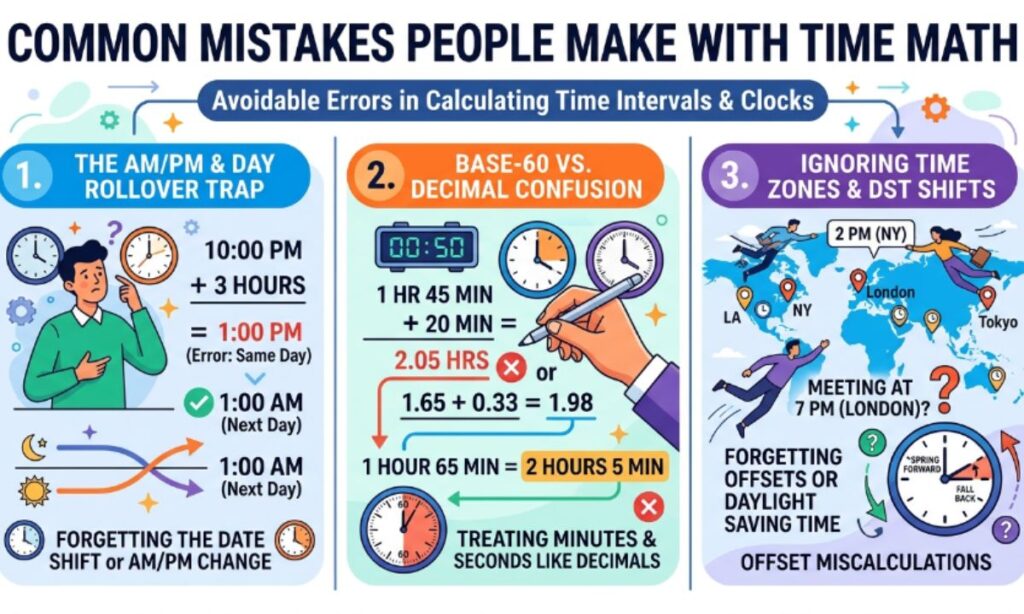
Time math looks simple until it isn’t, and a few small errors trip up almost everyone at some point.
Mixing up AM and PM. This is the single biggest source of wrong answers. A countdown to 11:15 AM and 11:15 PM can differ by up to 12 hours, so always double check which one you actually need.
Forgetting to roll over to the next day. If the target time has already passed today, the countdown needs to account for a full 24-hour cycle before landing on tomorrow’s occurrence. Skipping this step gives you a negative number that doesn’t mean anything useful.
Ignoring time zones during travel or remote scheduling. If you’re counting down to a meeting or flight in a different time zone, the local 11:15 where the event happens is what matters, not your own local clock.
Rounding too early. Rounding your current time to the nearest five or ten minutes before doing the subtraction compounds the error. Always use the exact minute if precision matters.
Confusing 11:15 with 11:50 or 1:15. It sounds silly, but misreading similar-looking numbers on a schedule or ticket is a common reason people end up with a countdown that’s off by close to an hour.
Why People Search “How Long Until 11:15”
Curiosity about a specific time down to the minute usually points to something concrete on the calendar. A few of the most common reasons include:
- A scheduled meeting or class. Plenty of workplaces and schools schedule things at odd quarter-hour marks like 11:15 instead of the more common top-of-the-hour slots.
- Travel departures. Flights, trains, and buses frequently list boarding or departure times at irregular minutes, and 11:15 is a common one for mid-morning or late-night departures.
- Appointments. Doctors, dentists, and service bookings often use 15-minute increments to fit more appointments into a day.
- Personal countdowns. Some people are simply watching the clock until a break, a call, or the end of a shift, and want an exact number rather than a rough guess.
Whatever the reason, the appeal of this kind of search is speed. Nobody wants to do subtraction by hand when they can get the answer instantly.
Related Time Calculations Worth Knowing
Once you’ve got the method down for 11:15, the same approach applies to any target time. A few related searches follow the identical process:
- How long until 12:00 PM (noon), which uses 720 minutes past midnight as the target
- How long until 3:30 PM, using 930 minutes past midnight
- How long until midnight, which is either 0 or 1440 depending on how you’re counting
- How long until a specific date, which swaps minutes for full days but uses the same subtraction logic
Learning the minutes-past-midnight trick once means you can answer nearly any “how long until” question without needing a separate tool every time.
Quick Reference Table: Common Countdown Scenarios
| Scenario | Target Time | Best Use Case |
| Morning meeting countdown | 11:15 AM | Work calls, classes, standups |
| Late-night event countdown | 11:15 PM | Flights, shifts, livestreams |
| Appointment countdown | 11:15 AM or PM | Medical, dental, service bookings |
| Travel departure countdown | 11:15 AM or PM (local time) | Flights, trains, buses |
Conclusion
Figuring out how long until 11:15 comes down to one simple habit: convert both times into minutes past midnight, subtract, and adjust for a day rollover if needed.
Once you know whether you’re aiming for the morning or the night version, the math takes seconds. Keep the tables above handy, or just remember that 11:15 AM sits at 675 minutes and 11:15 PM sits at 1395 minutes, and you’ll never have to guess again.
Frequently Asked Questions
How do I know if 11:15 means AM or PM?
Check the context it’s tied to, like a calendar invite, ticket, or schedule. If nothing specifies, assume the next upcoming 11:15 based on the current time.
What if 11:15 already passed today?
Add 24 hours to your calculation to find the time remaining until 11:15 occurs again tomorrow.
Is there a faster way than doing the math manually?
Yes, most phones and computers have a built-in clock or countdown app where you can enter the target time and get an instant result.
Does this method work for any time, not just 11:15?
Yes, the same minutes-past-midnight subtraction method works for calculating the time until any hour and minute combination.
Why do schedules use odd times like 11:15 instead of round numbers?
Fifteen-minute increments let institutions like schools, clinics, and transit systems fit more appointments or departures into a single day without wasted gaps.

James Anderson is a passionate English grammar writer at GlobalMegzine, sharing simple language tips, word meanings, slang guides, and easy grammar knowledge for everyday readers.