
Wondering how long until 4:30, whether it’s for a meeting, a workout timer, or just counting down to the end of your shift? This guide breaks down the exact math, gives you ready-made tables for common starting times, and shows you how to figure it out in seconds no matter what time it is right now.
Time countdown questions like this one pop up more than people expect. You glance at the clock, you have somewhere to be at 4:30, and you want a fast answer without doing mental math. That’s exactly what this article covers, along with the small details that trip people up.
Quick Answer
The time left until 4:30 depends entirely on the current time and whether you mean 4:30 AM or 4:30 PM. If it’s currently 2:00 PM and you’re counting toward 4:30 PM, you have 2 hours and 30 minutes left. If it’s 4:30 AM you’re aiming for and it’s currently 11:00 PM, you have 5 hours and 30 minutes to go.
The formula is simple: subtract your current time from 4:30, adjusting for AM or PM and rolling over to the next day if needed. The tables below walk through the most common scenarios so you don’t have to do the subtraction yourself.
Time Until 4:30 PM From Common Starting Points
| Current Time | Time Until 4:30 PM |
| 8:00 AM | 8 hours 30 minutes |
| 9:15 AM | 7 hours 15 minutes |
| 10:30 AM | 6 hours |
| 12:00 PM (noon) | 4 hours 30 minutes |
| 1:45 PM | 2 hours 45 minutes |
| 2:00 PM | 2 hours 30 minutes |
| 3:20 PM | 1 hour 10 minutes |
| 4:00 PM | 30 minutes |
| 4:15 PM | 15 minutes |
Time Until 4:30 AM From Common Starting Points
| Current Time | Time Until 4:30 AM |
| 7:00 PM | 9 hours 30 minutes |
| 9:30 PM | 7 hours |
| 11:00 PM | 5 hours 30 minutes |
| 12:00 AM (midnight) | 4 hours 30 minutes |
| 1:15 AM | 3 hours 15 minutes |
| 2:45 AM | 1 hour 45 minutes |
| 3:30 AM | 1 hour |
| 4:00 AM | 30 minutes |
How to Calculate Time Until 4:30
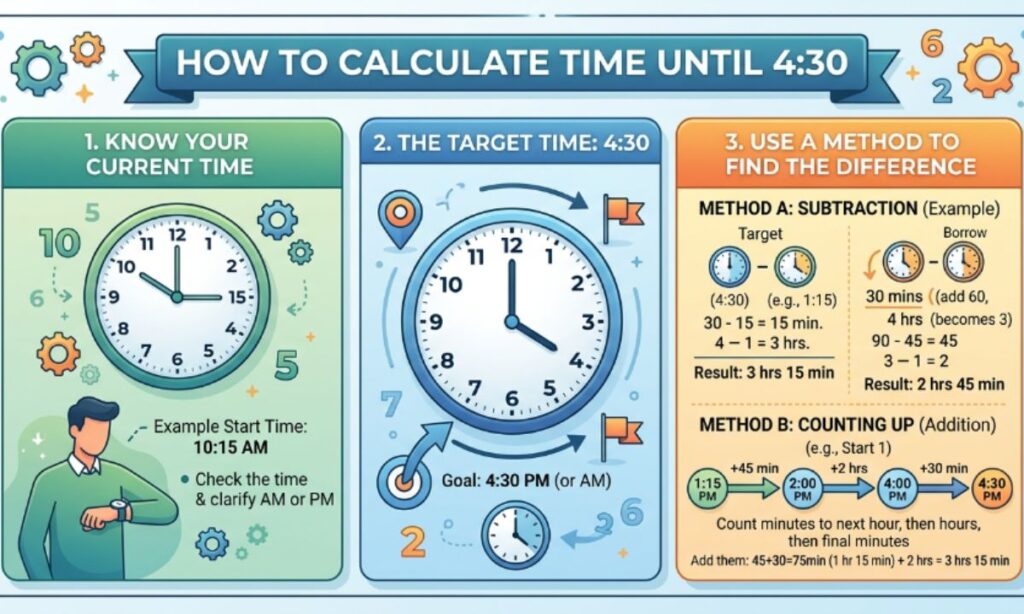
Working this out on your own is faster than it sounds once you know the pattern. Here’s the process broken into clear stages so you can apply it to any current time.
Step 1: Confirm AM or PM
Before anything else, decide whether your target 4:30 is in the morning or afternoon. This matters more than people think, because mixing up AM and PM throws the whole calculation off by twelve hours.
Step 2: Convert Both Times to a 24-Hour Format
Using 24-hour time removes the AM and PM confusion entirely. 4:30 PM becomes 16:30, and 4:30 AM stays as 04:30. Convert your current time the same way before doing any subtraction.
Step 3: Subtract Hours First
Take the hour of your target time and subtract the hour of your current time. For example, if it’s currently 13:00 and your target is 16:30, subtract 13 from 16 to get 3 hours as a starting point.
Step 4: Adjust the Minutes
Now compare the minutes. If your current time has zero minutes and the target has 30, you simply add those 30 minutes to your hour total from Step 3, landing on 3 hours 30 minutes.
Step 5: Handle the Rollover If Needed
If your current time’s minutes are higher than the target’s minutes, you’ll need to borrow an hour and adjust. Say it’s currently 13:45 and your target is 16:30. Subtract the hours first to get 3, then handle the minutes: 30 minus 45 is negative, so borrow an hour, making it 2 hours and 45 minutes.
4:30 AM vs 4:30 PM: Why the Difference Matters
People often type this question without specifying morning or evening, and it changes everything. 4:30 AM sits in the early hours before sunrise for most regions, often tied to early workouts, flights, or work shifts. 4:30 PM sits in late afternoon, closer to the end of a typical workday.
| Aspect | 4:30 AM | 4:30 PM |
| Time of day | Early morning | Late afternoon |
| Common uses | Waking up, early flights, gym sessions | End of workday, school pickup, evening plans |
| Light conditions | Usually dark or just before dawn | Usually daylight, especially in summer |
| Typical searches | “wake up alarms,” “early shift start” | “meeting countdown,” “clock out time” |
Common Mistakes People Make With This Calculation
A few small errors show up again and again when people try to figure out how long until 4:30 without a tool.
- Mixing up AM and PM. This is the single biggest source of wrong answers, since a twelve-hour mistake changes the entire result.
- Forgetting to roll over past midnight. If it’s 11:00 PM and your target is 4:30 AM the next day, you have to count into the following day, not treat it as a same-day gap.
- Rounding minutes carelessly. Rounding 27 minutes up to 30 feels harmless, but it adds up when you’re planning something time-sensitive like a departure.
- Ignoring time zones during travel. If you’re checking a countdown for an event happening somewhere else, your local 4:30 might not match theirs at all.
- Assuming today when the target is tomorrow. If the current time is already past 4:30, the countdown resets to the next day, not zero.
Why People Search “How Long Until 4:30”
This search shows up constantly, and the reasons behind it are more practical than curious.
- Work shift timing. Employees clocking in or out often watch the clock toward a specific quitting time like 4:30 PM.
- School and pickup schedules. Parents track countdowns to pickup or dismissal times that commonly land around this mark.
- Appointments and meetings. A scheduled call or appointment at 4:30 creates a natural need to know exactly how much time remains.
- Early morning routines. For 4:30 AM specifically, this often ties to gym habits, flight departures, or early work shifts.
- General time awareness. Sometimes it’s simply about pacing a task, wanting to know if there’s enough time left to finish something before that hour hits.
Real-World Scenarios Where This Matters
Knowing this countdown isn’t just trivia. It shapes small decisions throughout the day.
A retail worker on shift until 4:30 PM might use this to decide whether there’s time to squeeze in one more task before clocking out. A student with a 4:30 PM tutoring session uses the same math to figure out how long they have to finish homework first.
On the early side, someone with a 4:30 AM flight needs a precise countdown the night before to set an alarm that gives enough buffer for traffic and security lines. A morning workout routine built around a 4:30 AM wake-up depends on the same kind of calculation the night before.
Related Time Calculations You Might Need
If this countdown was useful, a few related calculations tend to come up in the same context.
- How long until 5:00, useful for anyone tracking a slightly later cutoff point in their day.
- How long until midnight, common for New Year’s countdowns or late-night deadlines.
- How many hours between two clock times, a broader version of this same subtraction method.
- Time zone conversions, needed when 4:30 in your location doesn’t match 4:30 somewhere else.
- Countdown to a specific date, which combines both day and time math rather than just the clock.
Conclusion
Figuring out how long until 4:30 comes down to one simple subtraction once you know whether you’re dealing with morning or afternoon. Convert to 24-hour time, subtract the hours, adjust the minutes, and account for any rollover past midnight. Whether you’re counting down to the end of a shift, a flight, or a meeting, the same five-step method works every time.
Frequently Asked Questions
How do I know if 4:30 means AM or PM?
Context usually tells you. Work shifts and meetings almost always mean PM, while wake-up alarms and early flights usually mean AM. When in doubt, check the source of the appointment.
What if it’s already past 4:30 today?
The countdown simply shifts to 4:30 the next day. Add the remaining hours in today plus the hours from midnight to 4:30 tomorrow.
Does this calculation change with time zones?
Yes. A countdown to 4:30 only works for your local time zone unless you convert the target time to match wherever you currently are.
Can I use this method for any target time, not just 4:30?
Absolutely. The same five-step process of converting to 24-hour time, subtracting hours, adjusting minutes, and handling rollover works for any clock time you’re counting toward.
Why does my phone’s countdown app give a different answer?
Most apps round to the nearest minute or use your device’s time zone setting, which can differ slightly from a manual calculation if your clock isn’t perfectly synced.

James Anderson is a passionate English grammar writer at GlobalMegzine, sharing simple language tips, word meanings, slang guides, and easy grammar knowledge for everyday readers.