
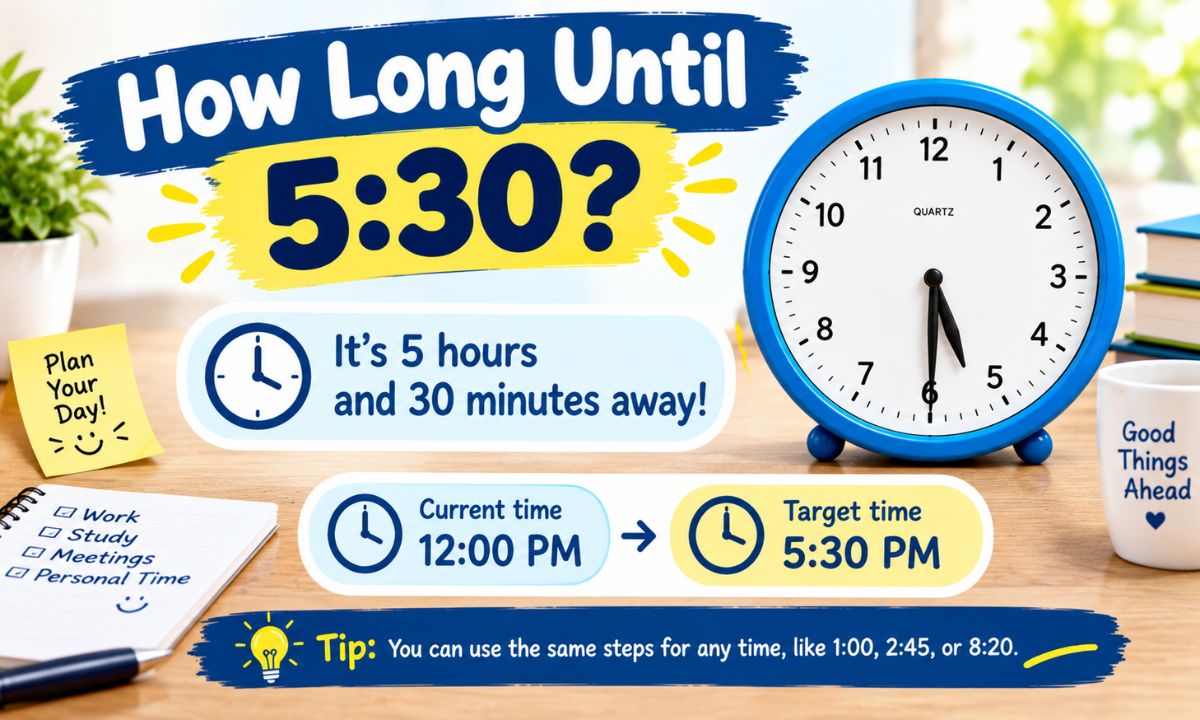
Wondering how long until 5:30, whether that’s 5:30 AM or 5:30 PM? The answer depends entirely on the current time you’re counting from. Below you’ll find the exact method to calculate it yourself, ready-made reference tables for common starting times, and answers to the questions people ask most about this exact topic.
Time-based questions like this pop up more often than you’d think. Maybe you’re waiting for a shift to end, counting down to a flight, or just trying to figure out how much daylight you have left before an appointment. Whatever the reason, getting the exact number of hours and minutes right matters, and it’s simpler than most people assume once you know the steps.
Quick Answer
There isn’t one single fixed answer to “how long until 5:30” because it changes every minute of every day. What you actually need is the gap between your current time and the next 5:30 mark, either AM or PM, whichever comes first.
Here’s the fastest way to think about it:
- If it’s currently before 5:30 AM, count forward to 5:30 AM.
- If it’s currently between 5:30 AM and 5:30 PM, count forward to 5:30 PM.
- If it’s currently after 5:30 PM, count forward to 5:30 AM the next day.
That simple rule covers every situation you’ll run into.
How to Calculate the Time Until 5:30
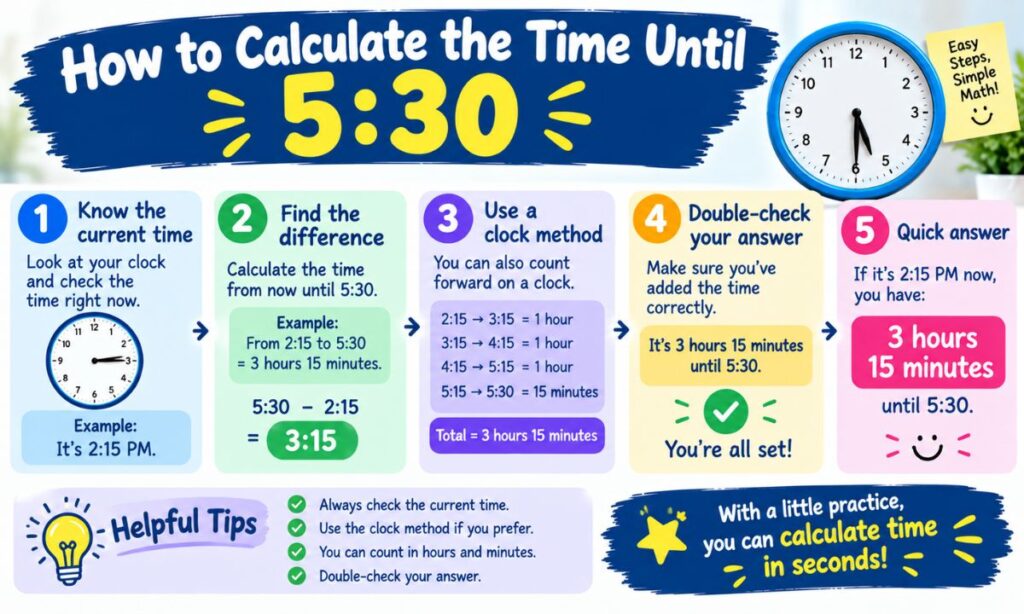
Calculating the exact time remaining is basic subtraction once you convert everything into the same format. Here’s the process broken down step by step.
Step 1: Note Your Current Time
Check the clock and write down the exact hour and minute. Precision matters here. “About 2 o’clock” won’t give you an accurate countdown, but “2:14 PM” will.
Step 2: Decide Which 5:30 You’re Targeting
Figure out whether you’re counting toward 5:30 AM or 5:30 PM. This depends on where your current time falls in the day, as explained in the quick answer above.
Step 3: Convert to 24-Hour Time
Working in 24-hour format removes any AM/PM confusion. Here’s the conversion:
| 12-Hour Format | 24-Hour Format |
| 5:30 AM | 05:30 |
| 5:30 PM | 17:30 |
Step 4: Subtract Current Time From Target Time
Subtract hours first, then minutes. If your minutes go negative, borrow an hour and add 60 minutes before subtracting.
Example 1: It’s currently 1:15 PM (13:15), and you want to know how long until 5:30 PM (17:30).
17:30 minus 13:15 equals 4 hours and 15 minutes.
Example 2: It’s currently 9:45 PM (21:45), and you want to know how long until 5:30 AM the next day (05:30 + 24:00 = 29:30).
29:30 minus 21:45 equals 7 hours and 45 minutes.
Step 5: Double-Check With Minutes
If you prefer working entirely in minutes, convert both times into total minutes since midnight, subtract, then convert the result back into hours and minutes. This method is handy if you’re building a spreadsheet formula or a simple script.
Reference Table: Common Starting Times to 5:30 PM
Use this table if you’re counting toward 5:30 PM specifically.
| Current Time | Time Until 5:30 PM |
| 8:00 AM | 9 hours 30 minutes |
| 9:30 AM | 8 hours |
| 11:00 AM | 6 hours 30 minutes |
| 12:00 PM (Noon) | 5 hours 30 minutes |
| 1:45 PM | 3 hours 45 minutes |
| 3:00 PM | 2 hours 30 minutes |
| 4:15 PM | 1 hour 15 minutes |
| 5:00 PM | 30 minutes |
Reference Table: Common Starting Times to 5:30 AM
Use this table if you’re counting toward 5:30 AM, either later tonight or the following morning.
| Current Time | Time Until 5:30 AM |
| 6:00 PM | 11 hours 30 minutes |
| 8:30 PM | 9 hours |
| 10:00 PM | 7 hours 30 minutes |
| 11:45 PM | 5 hours 45 minutes |
| 1:00 AM | 4 hours 30 minutes |
| 3:15 AM | 2 hours 15 minutes |
| 4:45 AM | 45 minutes |
| 5:00 AM | 30 minutes |
Real-World Scenarios Where This Calculation Matters
Work Shifts
Plenty of retail, hospitality, and warehouse jobs run shifts ending at 5:30, either morning or evening. Employees often glance at the clock and mentally calculate how much time is left before clocking out. Knowing the shortcut saves you from doing the math over and over during a long shift.
Travel and Commuting
If your train, flight, or bus departs at 5:30, counting backward from that time tells you exactly when to leave home, when to stop packing, and when to call a cab. Missing a tight window by even ten minutes can mean missing the departure entirely.
Appointments and Meetings
Doctor’s appointments, virtual meetings, and scheduled calls at 5:30 need the same kind of countdown. Knowing you have “two hours and ten minutes left” is far more useful for planning than a vague sense of “later this afternoon.”
Cooking and Timed Tasks
Recipes, laundry cycles, and other timed household tasks sometimes need to finish by a specific clock time. If dinner needs to be ready by 5:30 PM, working backward from that target tells you exactly when to start prepping.
Fasting and Health Routines
Intermittent fasting schedules, medication timing, and workout routines often revolve around specific clock times. If your eating window closes at 5:30 PM, tracking the remaining time helps you plan your last meal accurately.
Common Mistakes People Make With This Calculation
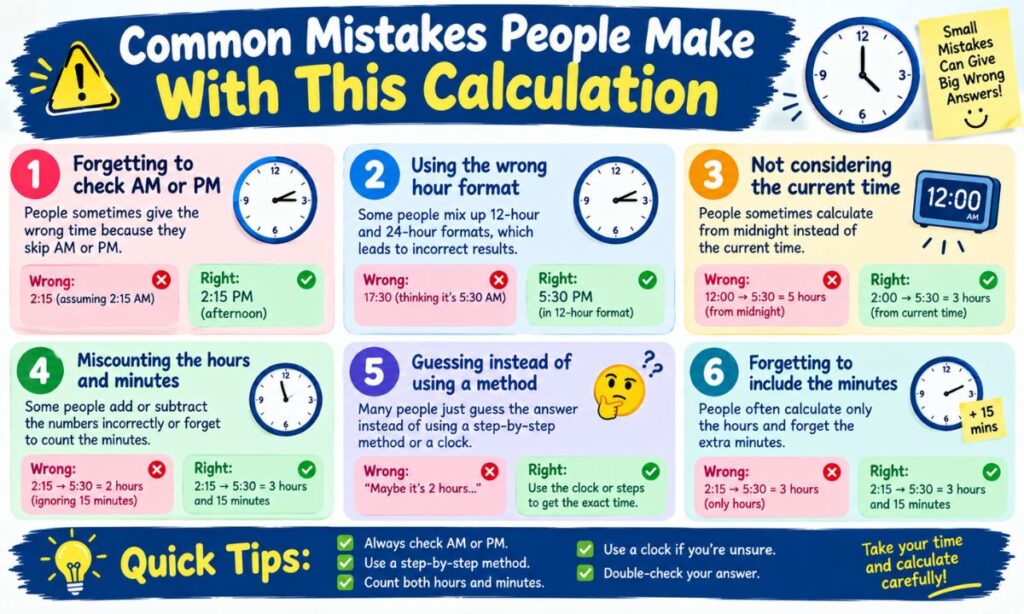
Confusing AM and PM
This is the single most common error. Someone means 5:30 in the evening but calculates against 5:30 in the morning, throwing the entire result off by twelve hours. Always confirm which 5:30 you actually mean before doing any math.
Forgetting to Cross Midnight
If your current time is late at night and your target is 5:30 AM, you have to add 24 hours to the target before subtracting. Skipping this step gives you a negative number that doesn’t make sense.
Rounding Too Early
Rounding “17 minutes” down to “15 minutes” or up to “20 minutes” seems harmless, but it adds up when you’re stacking several time calculations together, like figuring out a full day’s schedule.
Ignoring Time Zones
If you’re coordinating with someone in a different time zone and asking “how long until 5:30” without specifying whose 5:30 you mean, the math becomes meaningless. Always clarify the time zone first, especially for calls or virtual meetings.
Why People Search This Topic
Most searches for “how long until 5:30” come from people who want a fast, no-fuss answer without pulling out a calculator or opening an app. It’s a small, practical question, but it comes up constantly across everyday situations: work, school, travel, cooking, and personal routines all revolve around specific clock times.
There’s also a simple psychological reason. Counting down to a specific moment, whether it’s the end of a shift or the start of a trip, makes the wait feel more manageable. Having an exact number attached to that wait, rather than a vague sense of “not long now,” gives people a clearer mental anchor.
Related Calculations and Topics
If this kind of time math is useful to you, a few related calculations follow the exact same logic:
- How long until 6:00, using the identical subtraction method with a different target time.
- How long until midnight, which is especially useful for New Year’s countdowns or end-of-day deadlines.
- Converting between 12-hour and 24-hour time formats for scheduling software or international coordination.
- Calculating elapsed time between two events, which is the reverse version of this same subtraction process.
- Working out how many hours are left in a workday, school day, or shift based on a fixed end time.
Each of these builds on the same core skill: converting clock times into a consistent format, then subtracting one from the other.
Conclusion
Figuring out how long until 5:30 comes down to one thing: knowing your current time and picking the right target, whether that’s 5:30 AM or 5:30 PM. Once you convert both times into a matching format and subtract carefully, the answer takes seconds to work out. Use the tables above for a quick lookup, or run through the five-step method whenever your starting time isn’t already listed.
Frequently Asked Questions
How do I know if someone means 5:30 AM or 5:30 PM?
Context usually makes it clear, such as a work shift, appointment, or flight time. When in doubt, ask directly rather than guessing.
Is there a quick trick for calculating this without a calculator?
Round your current time to the nearest 15-minute mark, subtract in your head using that rounded number, then adjust by a few minutes for accuracy.
Does daylight saving time affect this calculation?
Only on the two days each year when clocks shift. On every other day, the calculation works exactly as shown here.
What if I’m counting across two different time zones?
Convert both times into the same time zone first. Skipping this step is the most common reason these calculations go wrong.
Can I use this method for any target time, not just 5:30?
Yes. The same five-step process works for any clock time you’re counting toward, whether that’s 5:30, 9:15, or midnight.

James Anderson is a passionate English grammar writer at GlobalMegzine, sharing simple language tips, word meanings, slang guides, and easy grammar knowledge for everyday readers.