
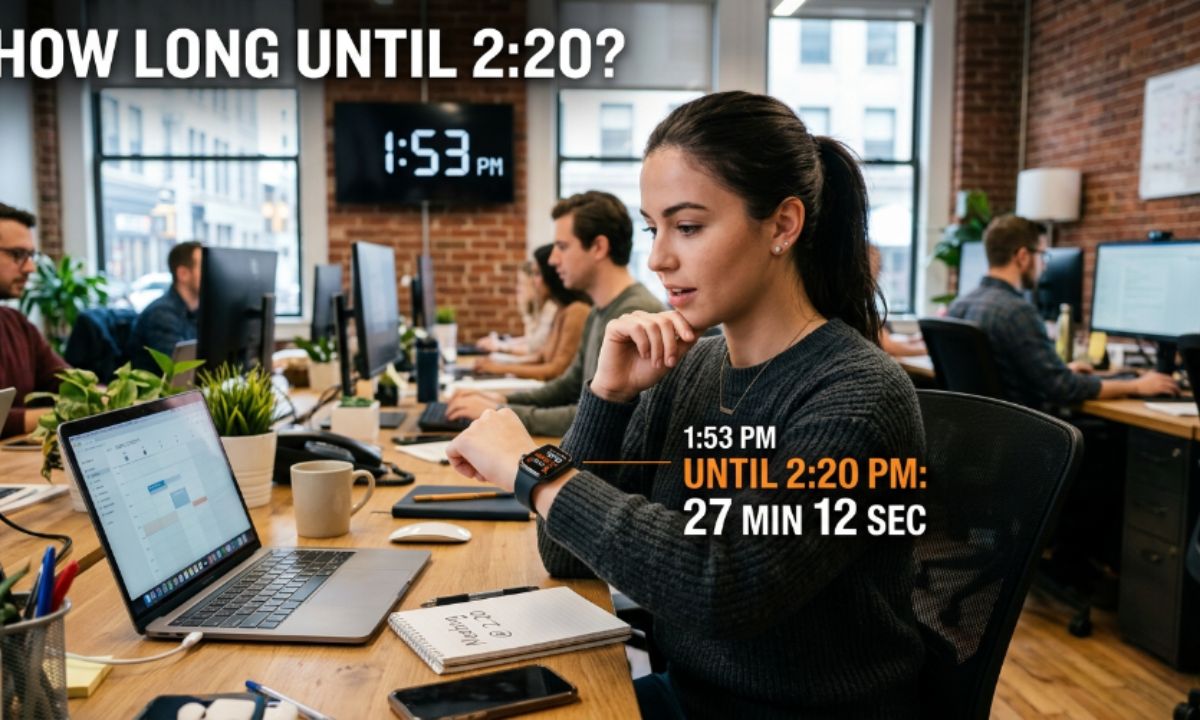
This guide shows you exactly how to figure out how long until 2:20, whether you mean 2:20 AM or 2:20 PM, using simple math you can do in your head or with a calculator. You’ll also find ready-made tables, common mistakes to avoid, and answers to the questions people ask most.
Ever glanced at the clock and wondered how much time is left until 2:20 hits? Maybe you’ve got a meeting scheduled then, a bus to catch, or you’re just counting down to the end of your shift. Whatever the reason, figuring out the exact gap between now and 2:20 is a simple subtraction problem once you know the trick.
This article walks through the whole process step by step, with real number examples so you’re not stuck doing mental gymnastics.
Quick Answer: How Long Until 2:20
The honest answer depends entirely on what time it is right now. There’s no single fixed number because “how long until 2:20” changes every minute of every day.
Here’s the shortcut formula:
Time Remaining = 2:20 (target time) − Current Time
If the current time is earlier in the day than 2:20, you just subtract. If it’s already past 2:20, you add 24 hours to the target time first, then subtract, since you’re really counting down to 2:20 the next day.
| Current Time | Target | Time Until 2:20 |
| 1:00 PM | 2:20 PM | 1 hour 20 minutes |
| 12:45 PM | 2:20 PM | 1 hour 35 minutes |
| 2:00 AM | 2:20 AM | 20 minutes |
| 3:00 PM | 2:20 PM (next day) | 23 hours 20 minutes |
| 11:50 PM | 2:20 AM (next day) | 2 hours 30 minutes |
How to Calculate the Time Until 2:20
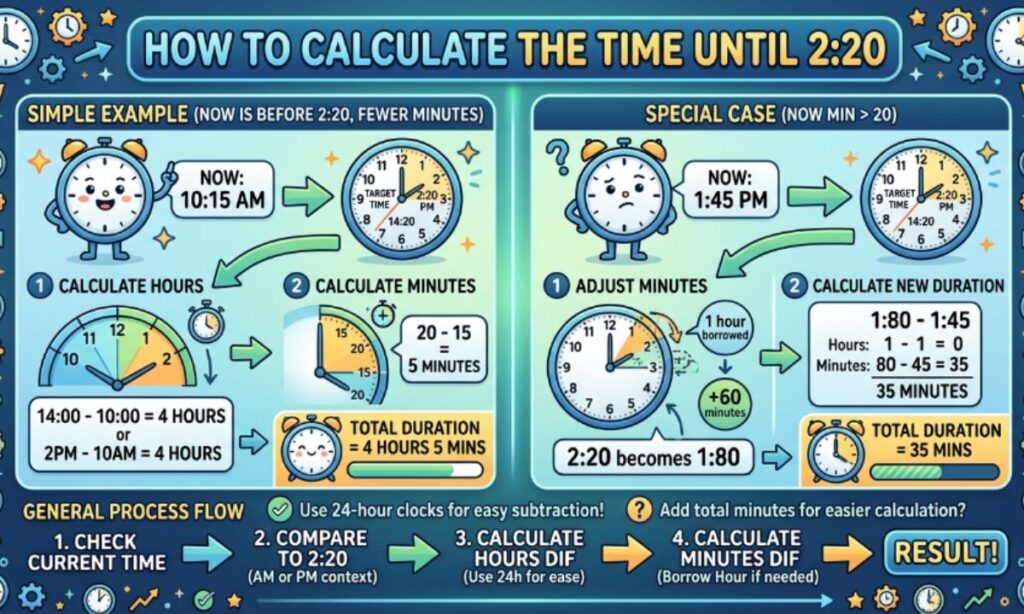
Working this out by hand is easier than it sounds. Here’s the method broken into clear steps.
Step 1: Confirm AM or PM
Before anything else, decide if you’re counting toward 2:20 AM or 2:20 PM. These are twelve hours apart, so mixing them up throws the whole calculation off.
Step 2: Convert Both Times to 24-Hour Format
Converting to 24-hour (military) time removes the guesswork around AM and PM. For example, 2:20 PM becomes 14:20, while 2:20 AM stays as 02:20.
Step 3: Subtract Current Time From Target Time
Once both times are in the same format, subtract minutes first, then hours. If the minutes in the current time are higher than the minutes in the target time, borrow an hour (60 minutes) from the hour column.
Step 4: Adjust for Crossing Midnight
If your current time is later than 2:20 and you’re aiming for the next occurrence, add 24 hours to the target before subtracting. This gives you the correct countdown across the day boundary.
Step 5: Double-Check With Minutes Only
A good sanity check is converting everything into total minutes since midnight, then subtracting. It’s slower but it catches errors from the hour-borrowing step.
| Step | What You Do | Example |
| 1 | Pick AM or PM | 2:20 PM |
| 2 | Convert to 24-hour format | 14:20 |
| 3 | Subtract current time | 14:20 − 13:05 = 1:15 |
| 4 | Adjust if past target | Add 24:00 if needed |
| 5 | Verify in total minutes | 860 − 785 = 75 min |
Real-World Examples
Numbers make more sense with context, so here are a few everyday scenarios.
Scenario 1: Catching an afternoon train It’s 12:30 PM and your train leaves at 2:20 PM. Subtracting gives you 1 hour and 50 minutes to get to the station.
Scenario 2: Early morning wake-up It’s 11:45 PM and your alarm is set for 2:20 AM. That’s 2 hours and 35 minutes away, so you’re looking at a short nap rather than a full night’s sleep.
Scenario 3: Work shift ending Your shift wraps up at 2:20 PM and the current time is 1:58 PM. That leaves just 22 minutes on the clock.
| Scenario | Now | Target | Time Left |
| Train departure | 12:30 PM | 2:20 PM | 1 hr 50 min |
| Alarm countdown | 11:45 PM | 2:20 AM | 2 hr 35 min |
| End of shift | 1:58 PM | 2:20 PM | 22 min |
| Lunch break starts | 11:00 AM | 2:20 PM | 3 hr 20 min |
Why People Search for “How Long Until 2:20”
This kind of query pops up more than you’d expect, and usually for practical reasons rather than idle curiosity.
- Appointments and meetings: People often check this right before a scheduled call or doctor’s visit to see how much prep time is left.
- Transportation deadlines: Flights, trains, and buses departing at 2:20 push travelers to calculate their remaining window.
- Work and school schedules: Classes, shifts, and exams ending or starting at 2:20 create a natural reason to count down.
- Daily routines and habits: Some people time naps, breaks, or workouts around specific clock numbers like 2:20 for consistency.
- Curiosity about the current moment: Sometimes it’s simply about knowing exactly how far away a specific time is, with no bigger plan attached.
Common Mistakes and Misconceptions
A few errors show up again and again when people try to do this math on the fly.
Confusing AM and PM
This is by far the most common slip. Someone means 2:20 in the afternoon but calculates against 2:20 in the morning, throwing the answer off by twelve hours.
Forgetting to Borrow an Hour
When the current minutes are higher than the target minutes, skipping the borrowing step gives a negative or nonsensical result. Always borrow 60 minutes from the hour column when needed.
Ignoring the Day Rollover
If the current time is already past 2:20, forgetting to add 24 hours means you’ll get a negative number instead of the correct next-day countdown.
Rounding Too Early
Rounding minutes before finishing the subtraction can introduce small errors that compound, especially when you’re stacking multiple time calculations together.
Mixing Time Zones
If you’re coordinating across regions, “2:20” in one zone isn’t the same clock reading in another. Always confirm which time zone the target refers to before calculating.
Related Calculations and Topics
If this kind of time math is useful to you, a few related calculations tend to come up in the same context.
- How long until 3:00: A similar countdown structure, just with a rounder target time.
- Time between two custom clock times: Useful when neither time is a landmark hour like noon or midnight.
- Converting 12-hour to 24-hour time: A foundational skill that makes every countdown calculation faster.
- Calculating elapsed time after an event: The reverse problem, working out how much time has passed since a fixed point rather than how much is left.
- Time zone conversion basics: Handy when the target time and your current time aren’t in the same zone.
| Related Topic | Why It’s Useful |
| How long until 3:00 | Same method, different target |
| 12-hour to 24-hour conversion | Removes AM/PM confusion |
| Elapsed time calculation | Reverse of a countdown |
| Time zone conversion | Needed for cross-region scheduling |
| Minutes-to-hours conversion | Helps read raw minute totals clearly |
Conclusion
Figuring out how long until 2:20 comes down to one simple subtraction, as long as you’re clear on AM versus PM and remember to adjust for crossing midnight.
Convert to 24-hour time, subtract carefully, and double-check with a minutes-only calculation if you want extra confidence. Once you’ve got the method down, you can apply it to any target time, not just 2:20.
Frequently Asked Questions
How do I know if someone means 2:20 AM or 2:20 PM?
Context usually tells you, such as whether the event is during typical daytime or nighttime hours. When in doubt, ask directly to avoid a twelve-hour mix-up.
What if the current time is already past 2:20?
Add 24 hours to the target time before subtracting, since you’re counting toward the next occurrence of 2:20 rather than one that already passed.
Can I calculate this without converting to 24-hour time?
Yes, but it’s easier to make mistakes with AM and PM labels. Converting first removes that risk entirely.
Does this method work for any target time, not just 2:20?
Absolutely. The same subtraction and midnight-adjustment steps apply no matter which specific time you’re counting down to.
Why does the answer change every time I check it?
Because the countdown is tied to the present moment. As real time moves forward, the gap between now and 2:20 shrinks accordingly.

James Anderson is a passionate English grammar writer at GlobalMegzine, sharing simple language tips, word meanings, slang guides, and easy grammar knowledge for everyday readers.