
Ever found yourself wondering exactly how long until 3:30? Whether you’re counting down to a meeting, a class, or just the end of your workday, knowing the precise time remaining can help you plan better and stay on track.
This guide breaks down everything you need to know about calculating the time until 3:30. From simple math tricks to quick reference points, you’ll have your answer in seconds, no confusion, no guesswork.
Quick Answer
The time remaining until 3:30 depends entirely on the current time you’re starting from. To get the answer, subtract your current time from 3:30 (using the correct AM or PM version). If the result is negative, that means 3:30 has already passed for today, and you should calculate toward 3:30 the next day instead.
For example, if it’s currently 1:15 PM, there are 2 hours and 15 minutes left until 3:30 PM. If it’s 5:00 PM already, then 3:30 PM has passed, and you’re really counting toward 3:30 AM or 3:30 PM tomorrow, whichever comes first.
How to Calculate Time Until 3:30
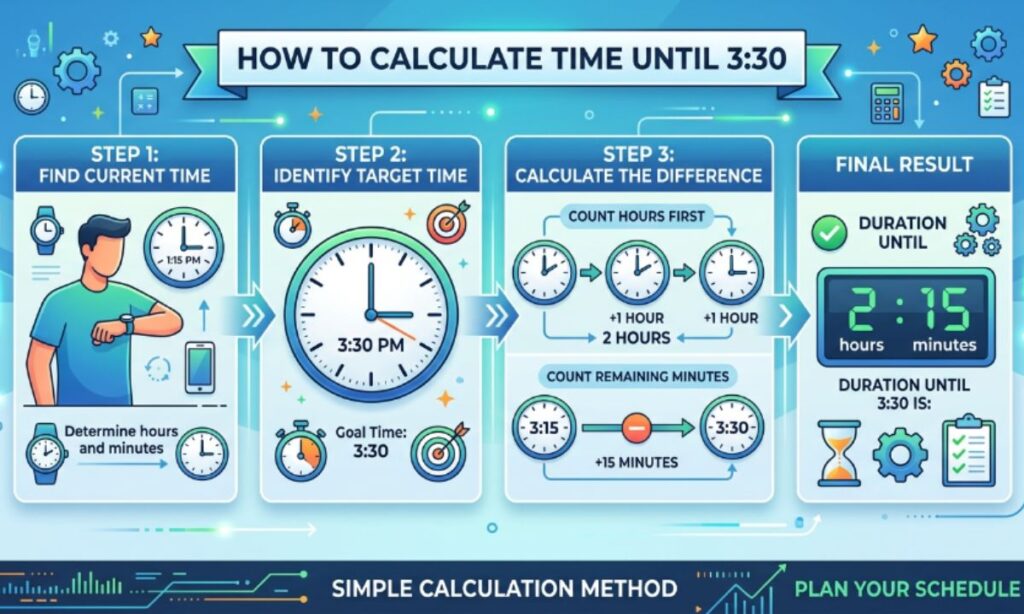
Doing this calculation is simple once you break it into small steps. Here’s the process anyone can follow, even without a calculator.
Step 1: Identify Your Current Time
Look at a clock or your phone and note the exact time, including minutes. Precision matters here because even a five-minute difference changes the final countdown number.
Step 2: Confirm Which 3:30 You Mean
Decide whether you’re counting down to 3:30 AM or 3:30 PM. This matters a lot, since mixing up AM and PM will throw off your entire calculation by twelve hours.
Step 3: Subtract Hours First
Subtract the hour portion of your current time from 3 (or 15 if you’re using 24-hour format for 3:30 PM). This gives you a rough hour count before you fine-tune with minutes.
Step 4: Adjust for Minutes
If your current minutes are higher than 30, you’ll need to borrow an hour and adjust the minute count accordingly. If your current minutes are lower than 30, the subtraction is straightforward.
Step 5: Combine Hours and Minutes
Add your adjusted hour count and minute count together for your final answer. This gives you the exact time remaining until 3:30.
Time Until 3:30 PM From Common Starting Points
Here’s a quick reference table showing how much time is left until 3:30 PM from various starting points throughout the day.
| Current Time | Time Until 3:30 PM |
| 6:00 AM | 9 hours 30 minutes |
| 8:30 AM | 7 hours |
| 10:00 AM | 5 hours 30 minutes |
| 12:00 PM | 3 hours 30 minutes |
| 1:15 PM | 2 hours 15 minutes |
| 2:45 PM | 45 minutes |
| 3:00 PM | 30 minutes |
| 3:29 PM | 1 minute |
Time Until 3:30 AM From Common Starting Points
If you’re counting down to 3:30 in the morning instead, the math shifts. Use this table if you’re up late or waking up early and need to know how long until 3:30 AM specifically.
| Current Time | Time Until 3:30 AM |
| 9:00 PM | 6 hours 30 minutes |
| 11:30 PM | 4 hours |
| 12:00 AM | 3 hours 30 minutes |
| 1:45 AM | 1 hour 45 minutes |
| 2:50 AM | 40 minutes |
| 3:15 AM | 15 minutes |
| 3:25 AM | 5 minutes |
Converting the Countdown Into Different Units
Sometimes minutes and hours aren’t the most useful way to think about a countdown. Depending on what you’re planning, it helps to see the same time gap expressed differently.
In Minutes Only
If it’s currently 1:00 PM and you’re counting toward 3:30 PM, that 2 hour and 30 minute gap converts to 150 minutes total. This format is useful for setting timers or reminders on your phone.
In Seconds
That same 150-minute gap equals 9,000 seconds. This level of detail rarely matters for everyday planning, but it’s handy for anyone working with countdown scripts, livestream timers, or scheduled automations.
As a Fraction of a Day
A gap of 2 hours 30 minutes represents roughly 10.4% of a full 24-hour day. This kind of framing helps when you’re trying to visualize how much of your day is left before a deadline.
Real-World Scenarios Where This Question Comes Up
People search “how long until 3:30” for all sorts of practical reasons, and the context usually shapes how urgent the answer feels.
- School pickup timing. Parents often need to know exactly how long until 3:30 PM dismissal so they can plan the drive, factor in traffic, and avoid sitting in a pickup line too early or arriving late.
- End of a work shift. Many retail and office shifts wrap up around 3:30, so employees track the countdown mentally to pace their remaining tasks.
- Appointment or meeting prep. If a call or appointment is set for 3:30, knowing the exact remaining time helps with last-minute prep, whether that’s finishing a report or driving to a clinic.
- Flight or train departures. Travelers frequently count down to boarding times listed as 3:30, especially when they still need to pack, commute, or clear security.
- Late-night or early-morning wake-ups. For 3:30 AM specifically, this often relates to early flights, shift work, or workout routines that start before sunrise.
Common Mistakes People Make With This Calculation
A few small errors trip people up constantly when they try to do this math without writing it down.
Mixing Up AM and PM
This is by far the most frequent mistake. Someone means 3:30 PM but calculates against 3:30 AM, or vice versa, and ends up with an answer that’s off by exactly twelve hours.
Forgetting to Borrow an Hour
When the current minute count is higher than 30, people often subtract straight across without adjusting the hour, which produces a negative or incorrect minute value.
Ignoring Time Zones
If you’re checking the time until 3:30 for an event happening somewhere else, forgetting the time zone difference can throw the whole calculation off by hours, not just minutes.
Rounding Too Early
Rounding 2 hours and 47 minutes down to “about 3 hours” feels harmless, but if you’re working against a tight deadline, that missing 13 minutes can matter more than expected.
Why This Specific Time Search Is So Common
3:30 sits at an interesting point in the day. It’s late enough that mornings are long gone, but early enough that it still feels like there’s real time left before evening. That in-between quality is exactly why so many schedules, school days, and shift patterns are built around it.
Search interest around specific times like 3:30 tends to spike around predictable daily patterns: school dismissal bells, mid-afternoon meeting slots, and shift-change hours at retail and service jobs. Because so many recurring daily events land near this exact time, the question “how long until 3:30” gets asked constantly, day after day, by people in completely different situations.
Related Time Calculations You Might Also Need
If this countdown was useful, a few related calculations often come up right alongside it.
- How long until 4:00, useful for anyone whose deadline or pickup time is slightly later than 3:30.
- How long until 3:00, helpful if you’re tracking an event that happens just before the half-hour mark.
- How many hours between two specific times, which is the broader version of this same calculation applied to any two points in the day.
- Converting a countdown into a percentage of your workday, handy for anyone trying to visualize how much of an eight-hour shift remains.
- Setting a recurring daily reminder for a fixed time, which removes the need to do this math manually every single day.
Conclusion
Figuring out how long until 3:30 really comes down to one simple subtraction, as long as you’re careful about AM versus PM and remember to borrow an hour when your current minutes pass the 30 mark.
Whether you’re timing a school pickup, wrapping up a shift, or prepping for a meeting, the tables and steps above should get you a fast, accurate answer every time without needing a calculator.
Frequently Asked Questions
How do I calculate how long until 3:30 PM from my current time?
Subtract your current time from 3:30 PM directly. If your minutes are higher than 30, borrow an hour first to keep the subtraction accurate.
Is 3:30 always PM unless stated otherwise?
Not necessarily. Many digital displays default to 3:30 PM in casual conversation, but always confirm AM or PM if the context isn’t obvious, especially for early morning schedules.
How many minutes are in the gap between 1:00 PM and 3:30 PM?
That gap equals 150 minutes total, which also converts to 2 hours and 30 minutes or 9,000 seconds.
Why do so many school and work schedules end near 3:30?
Many school days and retail shifts are structured to align with standard six to seven hour blocks starting mid-morning, which naturally lands dismissal or shift-end times close to 3:30.
What’s the easiest way to track a countdown to 3:30 without doing math manually?
Setting a phone alarm or calendar reminder for 3:30 directly removes the need for manual subtraction and gives you a live, automatic countdown instead.

James Anderson is a passionate English grammar writer at GlobalMegzine, sharing simple language tips, word meanings, slang guides, and easy grammar knowledge for everyday readers.